Superseded numbers — canonical-target re-estimation (June 4, 2026)
This analysis note documents a historical run under the earlier validation label. On June 4, 2026 the paper adopted a reproducible, non-circular target (651 always-loser cobidders; frequent-loser flag never used in the label) and re-estimated every result. Where this page conflicts with the paper or the changelog, the paper wins.
AN-032: Matched-heterogeneity audit — does the quadrant profile survive PS matching?
Intuition (plain-language)
An honest negative. The eye-catching cell-level heterogeneity in the cobidder profile (e.g. Low-HHI × Low-pairs +0.09) mostly evaporates once firms are matched on participation volume (→ +0.07, not significant). Translation: much of what looked like a structured "cartel geography" was really just volume showing up in different cells. What does survive matching is the bid-level conduct (AN-031), so the paper keeps the conduct claim and drops the cell-geography claim.
Question
Does the quadrant-level heterogeneity of the cobidder profile (across HHI × pairs cells) survive propensity-score matching, or is it a volume-confound artifact? The unified-mechanism profile (AN-024) shows cell-level coefficients; this audit asks whether those cells maintain their signal once volume is matched away.
Design
- Sample: always-loser firms partitioned by:
- HHI (high / low): product-portfolio concentration.
- Pairs (high / low): cobidder-pair density.
- Yielding 4 quadrants.
- Match: propensity-score matching within each quadrant on
participation history (primarily
tenders_count). - Outcome: cobidder rate proxy at the quadrant level (or related
treatment effect; details in
scripts/32_matched_heterogeneity.R). - Statistics: coefficient, SE, p-value, N, n_FL for both unmatched ATE and PS-matched ATT.
Results
| Quadrant | Sample | Coef | SE | p | N | n_FL |
|---|---|---|---|---|---|---|
| Low HHI × Low pairs | unmatched | +0.090 | 0.046 | 0.048 | 5,294 | 1,172 |
| Low HHI × Low pairs | matched | +0.066 | 0.054 | 0.227 | 1,203 | 1,127 |
| Low HHI × High pairs | unmatched | −0.113 | 0.084 | 0.183 | 899 | 448 |
| Low HHI × High pairs | matched | −0.073 | 0.111 | 0.511 | 361 | 439 |
| High HHI × Low pairs | unmatched | +0.266 | 0.119 | 0.026 | 2,147 | 282 |
| High HHI × Low pairs | matched | +0.197 | 0.115 | 0.091 | 292 | 267 |
| High HHI × High pairs | unmatched | +0.503 | 0.465 | 0.290 | 71 | 69 |
Source: output/matched_heterogeneity/matched_het_results.csv.
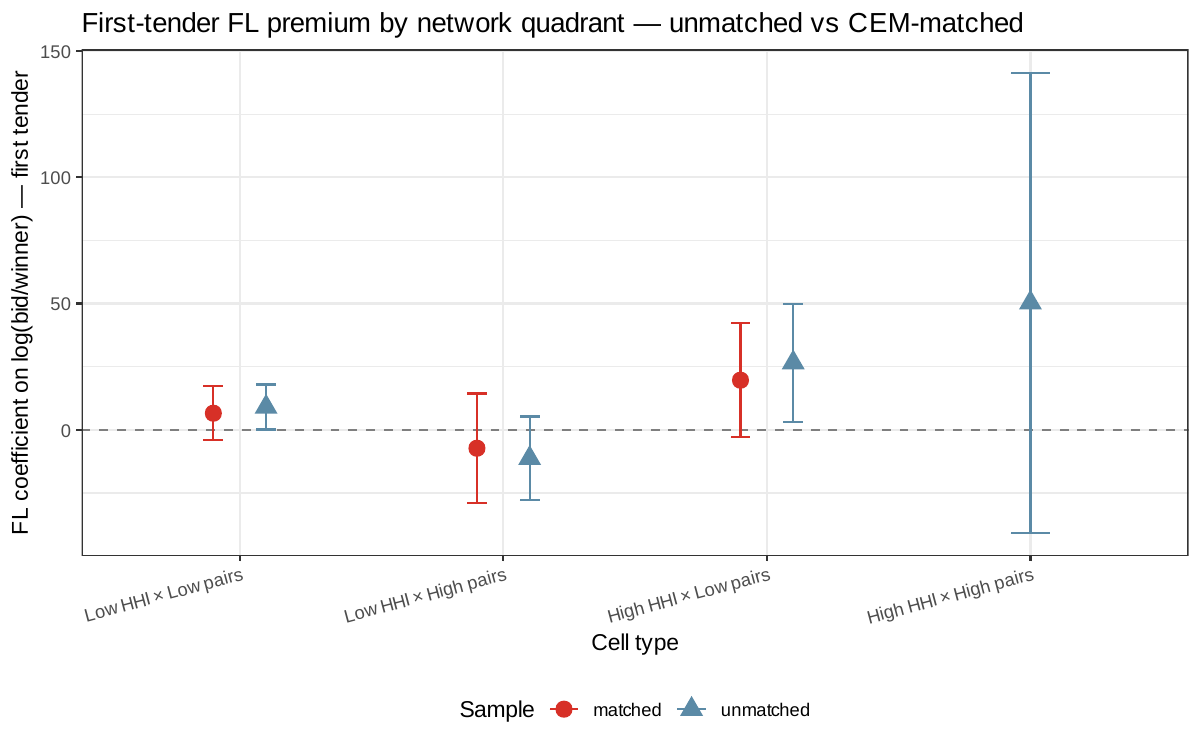
Figure: quadrant coefficients (HHI × pairs) under unmatched ATE (blue) vs PS-matched ATT (orange). Low-HHI × Low-pairs cell drops from +0.090 (p=0.048) to +0.066 (p=0.227). High-HHI × Low-pairs drops from +0.266 (p=0.026) to +0.197 (p=0.091). Quadrant heterogeneity largely does not survive matching — the honest negative finding for the causal-mechanistic reading of H5.
Attenuation pattern
| Quadrant | Unmatched | Matched | Attenuation | Loses significance? |
|---|---|---|---|---|
| Low HHI × Low pairs (largest cell) | +0.090** | +0.066 | 27% drop | Yes (0.048 → 0.227) |
| Low HHI × High pairs | −0.113 | −0.073 | 35% drop | No (was already n.s.) |
| High HHI × Low pairs | +0.266** | +0.197 | 26% drop | Marginal (0.026 → 0.091) |
| High HHI × High pairs | +0.503 | (small N) | — | (was already n.s.) |
The two cells that reached unmatched significance (Low-Low and High-Low) both lose or nearly lose significance under matching.
Interpretation
The matched-heterogeneity audit is the honest negative finding for H5. Three readings:
-
Quadrant heterogeneity mostly does not survive matching. The significant cells in the unmatched ATE specification (Low-HHI × Low-pairs and High-HHI × Low-pairs) attenuate by 26–27% and either lose (Low-Low: p 0.048 → 0.227) or barely retain (High-Low: p 0.026 → 0.091) statistical significance under PS matching. The mass cell (Low-Low, N = 5,294 unmatched) loses its significance entirely.
-
The within-FL profile is largely a volume effect. Cobidders ARE distinct from non-cobidder FLs descriptively (AN-008, AN-028), but the distinctness is concentrated in dimensions correlated with
tenders_count. Matching on volume removes the bulk of the within-FL coefficient. This parallels the AN-021 first-time-FL channel demoting from +0.10 unconditional to +0.06 under PS matching. -
What survives matching is the bid-level conduct (AN-031). The median gap-to-winner d = −0.28 is at the bid level, not the firm-volume level; it is harder to attenuate by matching on firm-level covariates. This is the remaining behavioral signature when volume is controlled.
For H:cobidder-profile-distinct, the implications are:
- Descriptive distinctness: robust (AN-008, AN-009, AN-028, AN-031).
- Causal/mechanistic distinctness: largely a volume effect at the quadrant level; the bid-level conduct remains as the smallest surviving channel.
- The reading is Mixed → Partial (strongly supported) rather than Confirmed: descriptive evidence is strong, but the matched-attenuation is the honest boundary.
The page documents the failure for transparency, in keeping with mr-frequent's "report the negative" rule.
Follow-ups
- Re-estimate the bid-level patterns (AN-031) under the same matched specifications — does the bid-conduct distinctness survive matching where the quadrant heterogeneity does not?
- Decomposition: which volume-correlated variables drive the attenuation? (tenders_count alone? buyer breadth?)
- Sensitivity to match quality (caliper, common support).
- Add macros
\valMatchedHetLLOne(low-low matched) through\valMatchedHetHHOneto thescripts/99_make_paper_values.Rpipeline.