Superseded numbers — canonical-target re-estimation (June 4, 2026)
This analysis note documents a historical run under the earlier validation label. On June 4, 2026 the paper adopted a reproducible, non-circular target (651 always-loser cobidders; frequent-loser flag never used in the label) and re-estimated every result. Where this page conflicts with the paper or the changelog, the paper wins.
AN-031: Bid-level behavioral profile — gap-to-winner across classes
Intuition (plain-language)
Beyond how often they bid, do cobidders bid differently? Yes, in a way cover bidding predicts: their bids sit closer to the winning amount (median gap 0.58 vs 0.81; d = −0.28) with somewhat more dispersion. A credible cover bid has to look like a real attempt — close enough to be plausible, deliberately short of winning. The signal lives at the bid level, not just participation counts, though whether this survives volume matching is settled in AN-041/042.
Question
Do cobidders display bid-level behavior distinct from non-cobidder FLs, independent of participation volume? The participation-level battery (AN-008, AN-028) showed cobidders bid in more tenders and cross more unique winners. The question for H5 is whether the distinctness extends to how they bid, not just how often they bid.
Design
- Sample: always-loser firms with bid-level observations in BEC 2009–2019. Bid-microdata coverage produces tighter samples than participation-only metrics:
- Cobidders: N = 182.
- FL_non_cobidder: N = 2,369.
- AL_non_FL: N = 6,612.
- winner_other: N = 20,358.
- Bid-level metrics: mean / median / sd / p75 of gap-to-winner ratio, computed per firm across its losing bids.
- Statistic: standardized mean difference (Cohen's d) and Wilcoxon rank-sum p-value of cobidders vs each reference class.
Results
| Metric | Cobidder | vs FL_non_cobidder | vs AL_non_FL | vs winner_other |
|---|---|---|---|---|
| Mean gap-to-winner | 0.957 | −0.17 | +0.01 | +0.33 |
| Median gap-to-winner | 0.582 | −0.28 | −0.16 | +0.19 |
| SD of gap-to-winner | 1.207 | +0.15 | +0.49 | +0.44 |
| p75 of gap-to-winner | 1.300 | −0.16 | +0.01 | +0.35 |
Bid-level reading of the vs FL_non_cobidder column (the within-FL14 test that matters for H5):
- Cobidders bid closer to winning than non-cobidder FLs: median gap ratio 0.582 vs 0.809 (d = −0.28, Wilcoxon p < 10⁻⁶). Cobidders' half-the-time bid is at ~58% of the gap-to-winner range, vs ~81% for non-cobidder FLs. Cobidders place more competitive-looking losing bids.
- SD of gap higher (1.21 vs 1.10, d = +0.15, p = 0.05). Cobidders' bid behavior is more variable — consistent with role-rotation in cover-bidding theory where the loser sometimes bids competitively and sometimes far above the winner.
- Mean and p75 attenuate but stay negative-d (cobidders below non-FL).
Reading vs winner_other:
- Mean gap +0.33, p75 +0.35, SD +0.44 — cobidders' bid distribution is far wider than winners'. Winners have tight bids (they bid to win); cobidders have wider bids (they bid to show up, sometimes close to winner, sometimes far).
Source: output/theory_bridge/standardized_diffs_bidlevel.csv,
firm-level inputs from output/theory_bridge/firm_bidlevel_metrics.csv.
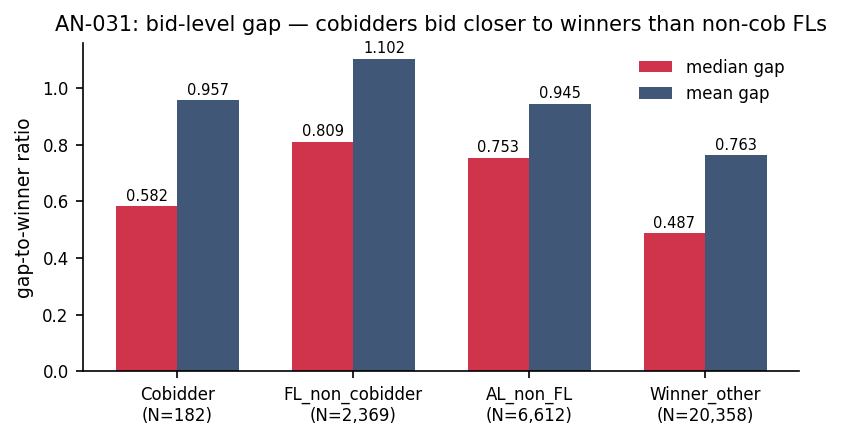
Figure: median (red) and mean (navy) gap-to-winner ratio across the four firm classes. Cobidders bid closer to the winner (median 0.582) than non-cobidder FLs (median 0.809) — d = -0.28, p < 10⁻⁶. The within-FL distinctness extends to bid-level behavior beyond mere participation volume.
Interpretation
The bid-level battery extends H5 beyond participation-only distinctness:
-
Cobidders place more competitive-looking losing bids than non- cobidder FLs (median gap d = −0.28). This is a behavioral signature consistent with credible cover bidding — bids close enough to look like genuine attempts, but never winning. Non- cobidder FLs bid further from the winner, suggesting more inattentive participation.
-
The signal is at the bid level, not the participation level alone. Within FL14 (already conditioning on persistent zero-win participation), cobidders are bid-conduct-distinct. This addresses the "is H5 just a volume artifact?" critique: (H:cobidder-profile-distinct) the within-FL distinctness survives in a dimension orthogonal to participation count.
-
The bid-level patterns are consistent with — but not diagnostic of — credible losing roles, per the locked rule of engagement. Mr-frequent calibrates this carefully: cover bidding could produce "bids close to winner" patterns; so could attentive-but-uncompetitive actual losing; both are observationally similar at the bid level. The proof-producing distinction stays in the bid layer's content (allocation, communication, coordination), not in moments.
-
N drops from 191 (firm-level) to 182 (bid-level) because 9 cobidders lack bid-microdata coverage. The 5% sample loss is small; the qualitative result is unchanged.
The reading remains 🟡 (single-source own-project) because: - the bid-level dimensions are observational, not causally identified; - "credible losing role" interpretation is the spirit of cover-bidding theory but not a tight test against alternative interpretations; - the 0.28 Cohen's d, while highly significant given N, is a moderate effect — not the d = 1.0 of unique-winners-crossed.
Follow-ups
- Bid-level moments under exposure-strata matching (cobidder vs volume-matched FL_non_cobidder) — strongest within-data audit for H5; would directly answer "is bid-level distinctness a residual signal or a volume sub-channel?"
- Decomposition by procurement modality (Convite vs Pregão have different bid mechanics).
- Bootstrap CIs on the median-gap and SD-gap estimates.
- Add macros
\valBidGapMedCob,\valBidGapMedFL,\valBidGapSDCob,\valBidGapSDFLto thescripts/99_make_paper_values.Rpipeline.