Superseded numbers — canonical-target re-estimation (June 4, 2026)
This analysis note documents a historical run under the earlier validation label. On June 4, 2026 the paper adopted a reproducible, non-circular target (651 always-loser cobidders; frequent-loser flag never used in the label) and re-estimated every result. Where this page conflicts with the paper or the changelog, the paper wins.
AN-021: First-time FL effect under PS matching
Intuition (plain-language)
Does becoming a frequent loser for the first time predict cobidder status — a quasi-dynamic signal? Unconditionally yes (+0.10). But the moment you match firms on participation history with propensity scores, the effect fades to +0.06 and loses significance (p = 0.31). Honest verdict: the "first-time" timing margin is mostly a volume story, not an independent signal. The paper reports it transparently and demotes it to the appendix rather than leaning on it.
Question
Does the "first-time FL" effect on cobidder concentration survive propensity-score matching? The matched estimate is the disciplined version of the unconditional comparison.
Design
- Sample: firms entering the FL14 stratum for the first time vs controls matched on participation history.
- Three disciplines:
- Unconditional: raw difference in cobidder indicator.
- Coarsened exact matching (CEM): matches on coarse strata.
- Propensity-score matching (PS): matches on the probability of becoming first-time-FL.
- Outcome: cobidder indicator.
Results
| Discipline | Coefficient | SE | p | N |
|---|---|---|---|---|
| Unconditional | +0.100*** | 0.043 | 0.019 | 9,118 |
| CEM | +0.085* | 0.048 | 0.076 | 1,930 |
| PS (matched) | +0.062 | 0.061 | 0.312 | 2,200 |
Macros: \valFTuncondCoef, \valFTuncondSE, \valFTuncondP,
\valFTuncondN, \valFTcemCoef, \valFTcemSE, \valFTcemP,
\valFTcemN, \valFTpsCoef, \valFTpsSE, \valFTpsP, \valFTpsN.
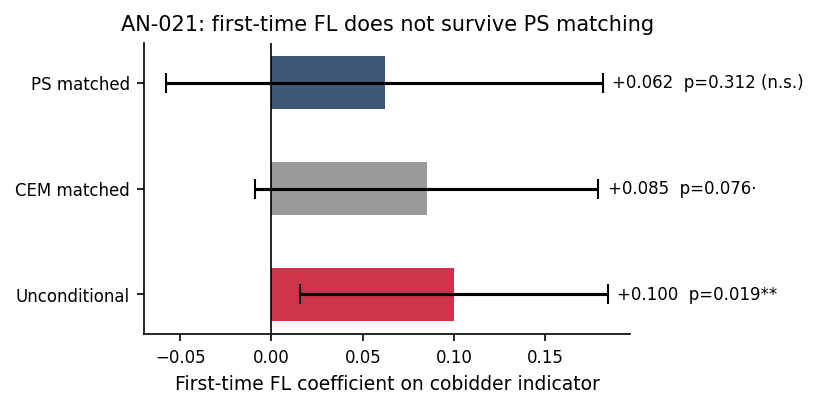
Figure: first-time-FL coefficient on cobidder indicator across three disciplines. Unconditional +0.100 (p=0.019, red = significant); CEM +0.085 (p=0.076, grey = marginal); PS-matched +0.062 (p=0.312, navy = n.s.). The channel does not survive PS matching — demoted to appendix.
Interpretation
The first-time-FL channel does not survive PS matching. The unconditional estimate (+0.10, p = 0.019) attenuates by ~40% under CEM (+0.085, p = 0.076) and collapses under PS (+0.062, p = 0.312). The coefficient retains its sign but loses statistical significance once participation-history confounding is removed.
Per the locked rule of engagement (mr-frequent rounds 2–4): the result is demoted to appendix. It is documented for transparency but not load-bearing for the paper's claims. The cobidder profile in AN-008 and AN-009 is the cross-sectional pattern that carries the cobidder-distinct narrative; the temporal "first-time" margin does not add a robust margin.
This is one of the JLEO-disciplinary moves: report the failure honestly, demote the result, avoid front-loading transient findings that do not survive matching.
Follow-ups
- Heterogeneity by match quality (caliper sensitivity).
- Alternative definitions of "first-time" (panel-window dependent).
- Triangulation with the unified-mechanism quadrants (AN-024).