H:utg-gap-selection-bounded — Court-mandated urgent purchases cost more than the closest administrative urgent comparison, and the gap survives selection bounding
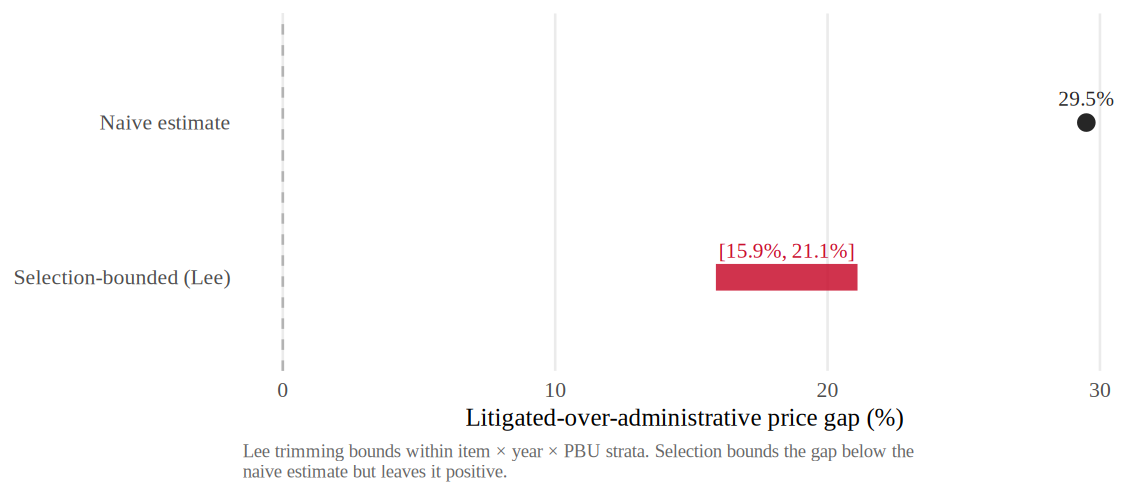
Holding urgency fixed, the paper compares purchases compelled by court order against the closest feasible urgent-procurement comparison: São Paulo's administrative-request channel, which produces urgent pharmaceutical purchases under the same compressed timelines and auction procedures but without the court-sanction regime. The naive comparison shows court-mandated (litigated) purchases costing substantially more. The administrative channel is selected, larger, and screened — not a randomized comparison and not free of selection — so the honest question is whether the gap survives once selection into that channel is bounded. The answer is that Lee bounds shrink the gap but keep it well above zero and statistically significant.
Economic intuition
Two urgent purchases, same kind of medicine, same compressed deadline — one forced by a court order, the other authorized through the state's administrative urgent route. The court-ordered ones look about 29.5% more expensive at face value. But the administrative route is screened: it tends to admit cases that were easier and cheaper to source in the first place, which makes the raw gap flattering. Lee bounds discipline that screening under a monotonicity restriction — they bound the selection rather than wiping it out — and even at the conservative end the court-order premium stays in the 15.9%–21.1% range and remains statistically distinguishable from zero.
Evidence strength: Partial (strongly supported). The naive under-the-gun (UTG) gap is 29.5% (coefficient −0.259, in the administrative-minus-litigated sign convention, so negative means litigated is more expensive). AN-002 reports Lee bounds of 15.9%–21.1% (lower-bound coefficient −0.148, upper −0.192) with a mean trimming rate of 26.9%. AN-007 returns a wild-cluster bootstrap p = 0.0080 under the preferred fixed effects and p = 0.0390 under item-by-year-month fixed effects. The gap is selection-bounded, not selection-free: the bound disciplines screening into the administrative channel rather than eliminating it.
Theory
Court mandates impose one-sided accountability: procurement officials face fines, civil liability, and other sanctions for failing to deliver a litigated medication on time, but no symmetric penalty attaches to paying a high price. In the passive-waste tradition (Bandiera, Prat & Valletti, 2009), this asymmetry predicts slack on the price margin precisely where delivery is enforced. The administrative urgent channel runs the same urgent auctions without the court-sanction regime, so it is the closest feasible urgent comparison for the court-mandated purchases. But the administrative channel is gated by the SES/SP scientific committee, which screens cases for admissibility — and that screening plausibly admits items that would have been cheaper to source under any regime. Lee's monotone trimming bounds (Lee, 2009) are the right instrument here: under a monotonicity restriction on selection, they bracket how much of the raw gap could be an artifact of differential composition between the channels.
Prediction
The administrative-minus-litigated log-price coefficient should be negative (litigated more expensive), and the implied litigated-over-administrative premium should remain positive and significant after Lee trimming. The preferred-FE specification should survive a wild-cluster bootstrap at conventional levels.
Competing prediction
Administrative selection (screening admits cheaper or easier cases). The leading alternative is that the entire gap is composition: the administrative committee screens in items that are intrinsically cheaper or easier to source, so the litigated channel looks expensive only because it carries the harder cases. This is exactly the channel Lee bounds are built to discipline. Under this story the gap should collapse toward zero once the more-selected channel is trimmed down to comparability. It does not: the bounds stay in the 15.9%–21.1% band. The Lee bound bounds selection under monotonicity, it does not eliminate it, so the conclusion is appropriately a bounded gap, not a point causal effect.
Setting evidence
São Paulo runs a parallel administrative-request channel for urgent pharmaceutical demand, authorized by the SES/SP scientific committee. It uses the same BEC auction procedures and faces the same compressed timelines and small quantities as litigated purchases, but it operates outside the court-sanction regime. This dual channel for urgent demand is the institutional asset that lets the comparison hold urgency fixed. Crucially, the administrative channel is larger and screened — administrative orders are about 3.3× larger than litigated orders (see H:lost-scale) — which is why it must be treated as a selected comparison and disciplined with bounds rather than read as a selection-free counterfactual. docs/paper.md gives the full institutional account.
Empirical test
- Outcome variable: log negotiated price.
- Variation: under-the-gun (UTG) contrast — litigated vs administrative urgent purchases, both inside urgent demand.
- Specification: fixed-effects regression of log negotiated price on an administrative indicator, with the preferred FE structure and an item-by-year-month alternative; sign convention is administrative-minus-litigated (negative = litigated more expensive), percentages reported litigated-over-administrative.
- Selection discipline: Lee monotone trimming bounds on selection into the administrative channel (mean trimming rate 26.9%).
- Inference: Rademacher wild-cluster bootstrap on the preferred-FE Admin coefficient.
- Sample: the urgent winner panel (naive regression N=61,620; Lee-trimmed 45,624).
Data requirements and limitations
Requires the BEC parquet cache restricted to urgent pharmaceutical demand. The administrative urgent channel is the closest feasible urgent-procurement comparison, not a randomized comparison and not free of selection: it is selected, larger, and screened. The Lee bound disciplines that selection under a monotonicity restriction; it does not turn the comparison into an experiment. The estimate is therefore a selection-bounded gap, reported as an interval, with the direction and lower bound load-bearing rather than any single point. The figure is a procurement-price gap; its fiscal translation is handled separately and is a procurement-cost calculation, not a full welfare estimate.
Evidence
| Analysis | Bearing | Key takeaway |
|---|---|---|
| AN-002 | Supports | Naive UTG gap 29.5% (coef −0.259); Lee bounds 15.9%–21.1% (lower coef −0.148, upper −0.192), mean trimming rate 26.9%. Selection-bounded gap stays well above zero. |
| AN-007 | Supports | Wild-cluster bootstrap p = 0.0080 (preferred FE), p = 0.0390 (item-by-year-month). Significance survives clustering-robust inference. |
Open tests
Tighten the bound with richer pre-screening covariates
The Lee bound trims on the observed selection margin. Incorporating additional admissibility covariates from the SES/SP screening process — if recoverable — could narrow the 15.9%–21.1% interval without weakening the monotonicity restriction. This is a precision improvement, not a change in the identification.
Map the bounded gap into its mechanism components
The selection-bounded UTG gap is the headline magnitude; the paper then asks why the gap arises. The within-firm-buyer-item null (H:no-broad-same-firm-markup) and the sourcing evidence (H:lost-scale, H:supplier-set-reallocation) decompose this gap; a tighter bridge from the bound to the decomposition would consolidate Clusters B and C.
Robustness to monotonicity violations (run)
The Lee interval assumes monotone selection into the administrative channel. We
relax it (analysis/60_referee_tests.R) by trimming an extra share \(\delta\) of
administrative observations to absorb potential monotonicity violators. The
litigated-over-administrative gap stays positive (litigated more expensive)
for extra trimming all the way past \(\delta = 0.60\), and is essentially unchanged
(≈[15.9%, 21.1%]) at a 10% slack. The headline direction is therefore robust to
substantial departures from monotonicity, even though the interval's exact width
remains conditional on the assumption.
Path to confirmation
Partial (strongly supported) is the ceiling for a single-jurisdiction design, and this hypothesis sits squarely on the project's load-bearing identifying assumptions: the Lee monotonicity restriction and the selection of the administrative urgent channel (a selected, larger, closest-feasible comparison, not a randomized one). Lifting the status would require evidence that does not rest on either:
- an exogenous or quasi-random source of sanction exposure — none is available in the São Paulo setting;
- cross-jurisdiction replication of the litigated-over-administrative gap (e.g., federal ComprasNet or another state platform); or
- an identifying design that does not use the administrative channel as the comparison.
Absent one of these, the gap remains selection-bounded under monotonicity, not point-identified. The paper states this directly, and the status reflects it — the hypothesis is not, and should not be, marked "confirmed."