H:lost-scale — Court-mandated buying gives up scale: administrative urgent orders are larger and capture bulk discounts
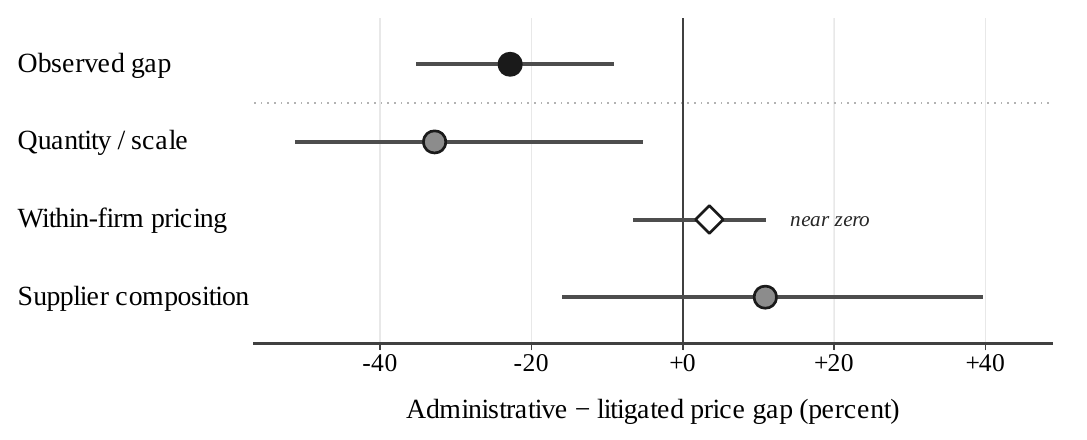
If the under-the-gun gap is not a broad same-firm markup in deep markets, where does the cost come from? The first sourcing channel is lost scale. Court mandates compel the state to source isolated emergencies one case at a time, while the administrative channel batches urgent demand into larger orders. Larger orders earn volume discounts, so the court-mandated channel forgoes the bulk-discount margin. The pricing-versus-sourcing decomposition shows that the quantity/scale component is the dominant piece of the observed gap.
Economic intuition
Buying one box at a time costs more per box than buying a pallet. Court orders force the state to source individual, urgent cases, so the lots stay small. The administrative urgent route, by contrast, batches demand into much larger orders — about 3.3 times larger — and larger orders pull volume discounts. When we decompose the price gap, the lost-scale piece is the big one: holding pricing fixed, the smaller court-ordered lots account for most of the cost difference. The court does not change what a supplier would charge for the same lot; it changes the size of the lot the state is allowed to buy.
Evidence strength: Partial (strongly supported). Administrative urgent orders are about 3.3× larger than litigated orders, and the estimated bulk-discount elasticity is −0.329 (AN-005). In the same Figure 1 decomposition (AN-005), the observed administrative-minus-litigated gap is −22.8%, of which the quantity/scale component is −32.8% (the dominant piece), the within-firm pricing component is +3.5% (near zero), and a supplier-composition residual is +10.9%. The within-firm near-zero term is consistent with the deep-market null (H:no-broad-same-firm-markup); the scale component is what carries the gap.
Theory
Demand aggregation is one of the central levers of procurement performance: pooling requirements into larger lots lets the state move down the supplier's cost curve and capture volume discounts (Lin & Wang, 2025). The passive-waste view (Bandiera, Prat & Valletti, 2009) predicts that institutional features which fragment demand — here, one-sided legal urgency that forces case-by-case sourcing — raise costs not through corrupt pricing but through lost scale. The mechanism is mechanical in the bulk-discount elasticity: if larger orders command lower unit prices, then a regime that shrinks order size raises unit cost even when no supplier marks anything up. This is why the decomposition holds within-firm pricing fixed and reads the scale component separately.
Prediction
- Administrative urgent orders should be larger than litigated urgent orders.
- The bulk-discount elasticity should be negative (larger orders, lower unit price).
- In the decomposition, the quantity/scale component should be a large negative share of the observed gap, while the within-firm pricing component is near zero.
Competing prediction
Pricing, not scale. The alternative is that the gap is driven by what suppliers charge rather than by how much the state buys — i.e., the cost lives in the within-firm pricing term, not the quantity term. The decomposition rejects this: the within-firm pricing component is +3.5% (near zero), while the quantity/scale component is −32.8%. A second alternative is that the supplier-composition residual (+10.9%) carries the story; that residual is a reconciliation residual, not standalone proof of sourcing — it must be read together with the winner-switching evidence in H:supplier-set-reallocation, which provides the direct supplier-set evidence.
Setting evidence
The litigated channel sources individual court-ordered cases under tight deadlines, which keeps lot sizes small. The administrative channel, authorized by the SES/SP scientific committee, can batch urgent demand into larger orders. The roughly 3.3× size difference is a direct institutional consequence of how each channel aggregates (or fails to aggregate) urgent demand. The policy implication in docs/paper.md — framework agreements and pooled urgent procurement to restore scale — follows directly from this margin.
Empirical test
- Outcome variables: order size (quantity) by regime; log negotiated price as a function of order size (bulk-discount elasticity).
- Decomposition: administrative-minus-litigated gap split into a quantity/scale component, a within-firm pricing component, and a supplier-composition residual (Figure 1).
- Specification: aggregation-cell analysis relating unit price to lot size, plus the additive decomposition of the observed gap.
- Sample: urgent panel; aggregation cells for the elasticity.
Data requirements and limitations
Requires the BEC urgent panel with order quantities and the decomposition inputs. The decomposition is accounting, not a structural counterfactual: it allocates the observed gap into additive components under a fixed scheme. The supplier-composition term is a reconciliation residual that should not be read as standalone proof of the sourcing mechanism; the direct sourcing evidence is the winner-switching table in H:supplier-set-reallocation. The bulk-discount elasticity is estimated from observed lot-size variation and inherits the usual caveats about unobserved item heterogeneity across lot sizes.
Evidence
| Analysis | Bearing | Key takeaway |
|---|---|---|
| AN-005 | Supports | Figure 1 decomposition (admin minus litigated): observed gap −22.8%; quantity/scale −32.8% (dominant); within-firm pricing +3.5% (near zero); supplier-composition residual +10.9% (a reconciliation residual, read with the winner-switching table). Administrative orders ~3.3× larger than litigated; bulk-discount elasticity −0.329, so larger lots earn lower unit prices. |
| AN-009 | Supports | Aggregation within buyer-item-month cells: administrative cells carry larger total accepted quantity (greater scale); litigated cells split demand across more repeated purchase-offer-items (more fragmented). Diagnostic, read with the decomposition and winner-switching evidence. |
61_h4_quantity_quartiles.R |
Supports | Direct within firm-buyer-item bulk discount: holding firm, buyer, and item fixed, the log-quantity coefficient is −0.259 (SE 0.074). The quantity gradient in the within-firm price difference is this scale channel, not same-firm pricing. |
Cross-link: the near-zero within-firm pricing component echoes H:no-broad-same-firm-markup; the supplier-composition residual is interpreted through H:supplier-set-reallocation.
Open tests
Counterfactual lot-size aggregation
Using the estimated bulk-discount elasticity (−0.329), simulate the unit price the litigated channel would have paid had its demand been aggregated to administrative-channel lot sizes. This would translate the lost-scale margin into a concrete "scale-restored" price, sharpening the framework-agreement policy lever — but it is a simulation, not a realized counterfactual, and should be labeled as such.
Separate within-molecule from across-molecule aggregation
The 3.3× size gap could reflect pooling within a molecule or shifting the mix of molecules procured. Decomposing the scale margin into within- and across-molecule aggregation would clarify which aggregation routine the policy response should rebuild.