H:supplier-set-reallocation — Legal urgency reallocates the winning supplier set
The second sourcing channel is supplier-set reallocation. Beyond buying smaller lots (H:lost-scale), court-mandated urgency changes who wins. If we line up the same item bought by the same buyer under both urgent regimes, the set of winning firms differs substantially across regimes — often with no overlap at all, and usually with a different modal winner. This is the direct evidence that legal urgency reallocates the supplier set, and it is what gives the +10.9% supplier-composition residual in the decomposition its interpretation. The cost margin in deep markets operates through how the state is forced to buy — a reshuffled supplier set — rather than through an incumbent marking up the same item.
Economic intuition
Take the same medicine bought by the same buyer, once under a court order and once through the administrative urgent route, and ask: are the winning suppliers the same firms? Mostly not. In about half of these matched pairs the two regimes share no winning supplier at all, and in seven out of ten the single most common winner is a different firm. So legal urgency does not just change the price or the lot size — it changes the cast of suppliers the state ends up buying from. That reshuffling is a real sourcing channel, and it is why the decomposition leaves a supplier-composition piece that the same-firm pricing test alone cannot explain.
Evidence strength: Partial (strongly supported). Across 2,134 item-buyer pairs observed under both regimes, AN-006 reports a mean winner-set Jaccard similarity of 0.268, with 48.5% of pairs sharing no winner overlap and the modal winner differing in 70.2% of pairs. This is the direct sourcing evidence that gives the +10.9% supplier-composition residual in the Figure 1 decomposition (AN-005) its substantive reading; the residual on its own is a reconciliation residual, not standalone proof, and is meant to be read together with this winner-switching table.
Theory
Procurement cost is shaped not only by price-per-lot but by which suppliers the state matches with. In the passive-waste tradition (Bandiera, Prat & Valletti, 2009), institutional frictions that disrupt routine supplier matching can raise costs even absent any change in posted prices, because the buyer ends up with a less favorable supplier set. One-sided legal urgency disrupts the matching routine: deadline pressure and case-by-case sourcing pull the state toward whichever qualified firm can deliver now, rather than the firm that would win an unconstrained urgent auction. The result is supplier-set reallocation — a different cast of winners — which is observationally distinct from a same-firm markup and from pure lot-size effects, and which the within-triple design deliberately conditions away in order to isolate same-firm pricing.
Prediction
For items bought by the same buyer under both urgent regimes, the winning supplier set should differ across regimes: low Jaccard similarity, a high share of pairs with no winner overlap, and a different modal winner in most pairs. If sourcing were unchanged, these pairs would show high similarity and a stable modal winner.
Competing prediction
Stable supplier set (sourcing unchanged). The alternative is that the same firms win regardless of regime, so the cost gap cannot be a sourcing phenomenon — it would have to be price or scale. The winner-switching evidence rejects this: mean Jaccard 0.268, 48.5% with no overlap, modal winner differs in 70.2% of pairs. A second alternative reads the +10.9% supplier-composition residual as the whole sourcing story; that residual is a reconciliation residual, not standalone proof of sourcing, which is precisely why this hypothesis supplies the direct winner-switching evidence rather than leaning on the decomposition term.
Setting evidence
Because the two urgent regimes run the same BEC auction procedures on overlapping items and buyers, the data contain 2,134 item-buyer pairs observed under both regimes — the natural sample for asking whether the winning supplier set is stable across regimes. The deadline-driven, case-by-case nature of litigated sourcing, described in docs/paper.md, is the institutional reason the matching routine is disrupted under court mandate.
Empirical test
- Outcome: similarity of the winning supplier set across regimes, per item-buyer pair.
- Measures: winner-set Jaccard similarity; share of pairs with zero winner overlap; share of pairs whose modal winner differs across regimes.
- Sample: 2,134 item-buyer pairs observed under both the litigated and administrative urgent regimes.
Data requirements and limitations
Requires the BEC urgent panel with winner identities linked across regimes for the same item-buyer pair. The measures are descriptive characterizations of supplier-set turnover; they document that the winning set reshuffles under legal urgency but do not by themselves price that reshuffling. The pricing magnitude attached to supplier composition is the +10.9% decomposition residual in H:lost-scale, which is a reconciliation residual to be read together with this winner-switching table, not as a standalone causal estimate. Winner turnover could in principle reflect supply-side availability shocks rather than the regime per se; the within-item-buyer structure limits but does not fully eliminate that concern.
Evidence
| Analysis | Bearing | Key takeaway |
|---|---|---|
| AN-006 | Supports | 2,134 item-buyer pairs under both regimes: mean winner-set Jaccard 0.268; 48.5% with no winner overlap; modal winner differs in 70.2% of pairs. Direct evidence that legal urgency reallocates the supplier set. |
| AN-005 | Supports (interpretive) | Supplier-composition residual +10.9% in the Figure 1 decomposition; a reconciliation residual whose substantive reading rests on the winner-switching table above, not on the residual alone. |
Together with H:lost-scale, this hypothesis makes the sourcing case: court mandates change how the state buys — smaller lots and a reshuffled supplier set — which is the mechanism behind the cross-cutting finding no broad same-firm markup in deep markets.
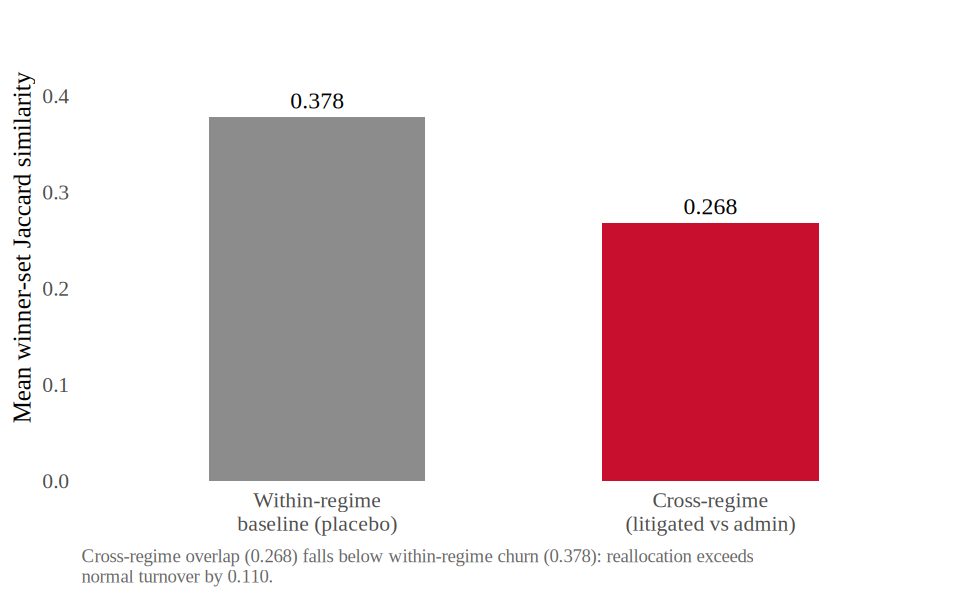
Reallocation exceeds baseline churn (run)
A skeptic could ask whether a 70.2% different-modal-winner rate is just normal
supplier turnover. It is not. Benchmarking the cross-regime winner-set similarity
against a within-regime placebo — randomly splitting each regime's purchases for
the same item-buyer pair into halves and computing their winner-set overlap
(analysis/60_referee_tests.R) — the within-regime baseline Jaccard is 0.378,
while the cross-regime Jaccard is only 0.268 (a gap of 0.109). The regime
change pushes winner-set overlap well below normal churn, so the reallocation
is specific to the litigated-versus-administrative contrast rather than
background turnover.
Open tests
Price the supplier switch directly
Rather than reading supplier composition off the decomposition residual, estimate the price difference between the regime-specific winning firms holding item and buyer fixed. A direct switch-price estimate would convert the descriptive turnover statistics into a priced sourcing margin and reduce reliance on the reconciliation residual.
Characterize the replacement suppliers
Who wins under court mandate that would not win administratively? Profiling the displaced versus replacement firms (size, distance, prior contract history) would clarify whether the reallocation is toward less efficient suppliers, which is what the lost-scale-plus-reallocation account implies, and would inform the pre-contracted-supplier policy lever.