AN-006: Winner switching across urgent regimes
Economic intuition
Take a buyer that bought the same item both ways — once on an administrative urgent order and once under a court mandate — and ask: did the same firm win, or did someone else step in? If litigation mainly raised the same supplier's price, the winners would largely match. They do not. Across these pairs, the winning supplier sets barely overlap — about a quarter of overlap on average — and in nearly half the pairs there is no overlap at all. The most common winner is a different firm in about seven of every ten pairs. The supplier set, not just the price, moves with the regime.
Question
When the same buyer buys the same item under both urgent regimes, does the set of winning suppliers change? This is the direct evidence on the supplier-set reallocation margin that the supplier-composition residual in AN-005 points to: if litigation worked through the same firm's price, the winner sets should largely coincide.
Design
- Sample: 2,134 buyer×item pairs observed under both urgent regimes — each pair has at least one administrative and at least one litigated urgent purchase.
- Unit: a buyer×item pair with ≥1 administrative and ≥1 litigated urgent purchase.
- Specification: within each pair, compare the set of winning suppliers across the administrative and litigated urgent regimes — distinct-winner counts, winner-set Jaccard similarity, any-overlap share, and whether the modal winner changes.
Results
| Measure | Value |
|---|---|
| Buyer×item pairs (both regimes) | 2,134 |
| Mean distinct winners — administrative | ~2.05 |
| Mean distinct winners — litigated | ~1.99 |
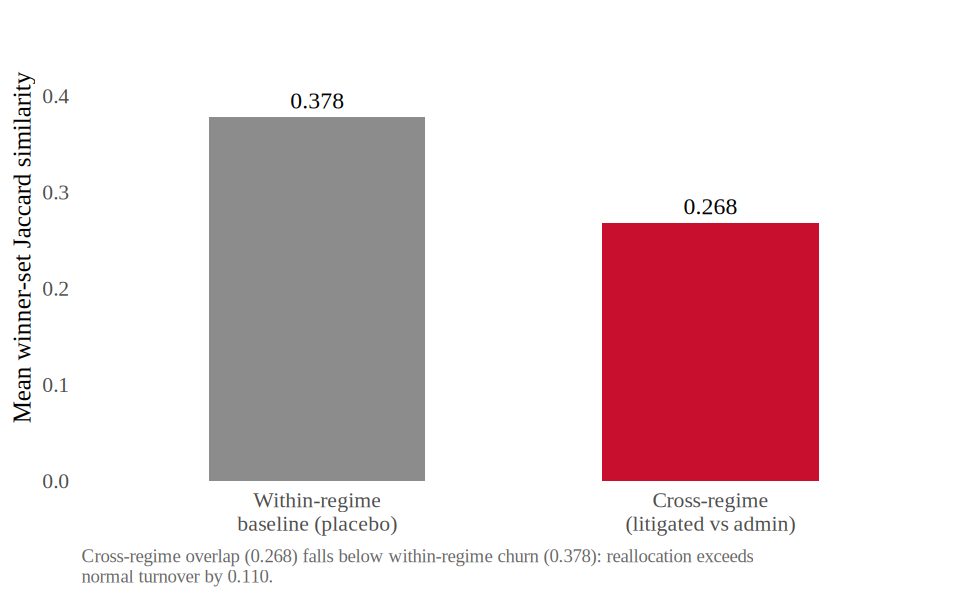
| Mean winner-set Jaccard similarity | 0.268 |
| No winner overlap | 48.5% |
| Any winner overlap | 51.5% |
| Modal winner differs | 70.2% |
| Same modal winner | 29.8% |
Output: v10-causal-mechanism/output/tables/tab_winner_switch.tex.
Interpretation
The winning supplier set moves with the regime. Across 2,134 buyer×item pairs observed under both urgent regimes, the mean winner-set Jaccard similarity is just 0.268, and 48.5% of pairs share no winners at all (51.5% share at least one). The modal winner differs in 70.2% of pairs and coincides in only 29.8%. The mean number of distinct winners is similar across regimes (~2.05 administrative, ~1.99 litigated), so the change is in which firms win, not in how concentrated each regime is.
This is the direct counterpart to the supplier-composition residual in AN-005: the supplier set, not just the supplier's price, reallocates under litigation. Together with the near-zero within-firm pricing margin in AN-003, it supports the core reading that in deep repeated urgent markets the cost margin is fragmented sourcing rather than a broad same-firm markup.
Confidence: green for the stated descriptive question. The analysis directly measures whether the winning supplier set changes within buyer-item pairs observed under both urgent regimes, and the answer is large: low Jaccard similarity, many zero-overlap pairs, and a different modal winner in most pairs. This is not a causal identification design and does not make the administrative channel random; the green rating is only for the descriptive supplier-set reallocation fact.
Follow-ups
- Quantify how much of the −22.8% gap the winner-set reallocation can account for, sharpening the supplier-composition residual — see AN-005.
- Check whether winner switching is more pronounced in the thin and off-formulary markets where the deep-market within-firm null breaks down — see AN-004.
- Validate the regime classification underlying the pairs — see AN-012.