AN-004: Market-depth and formulary heterogeneity in the urgent gap
Economic intuition
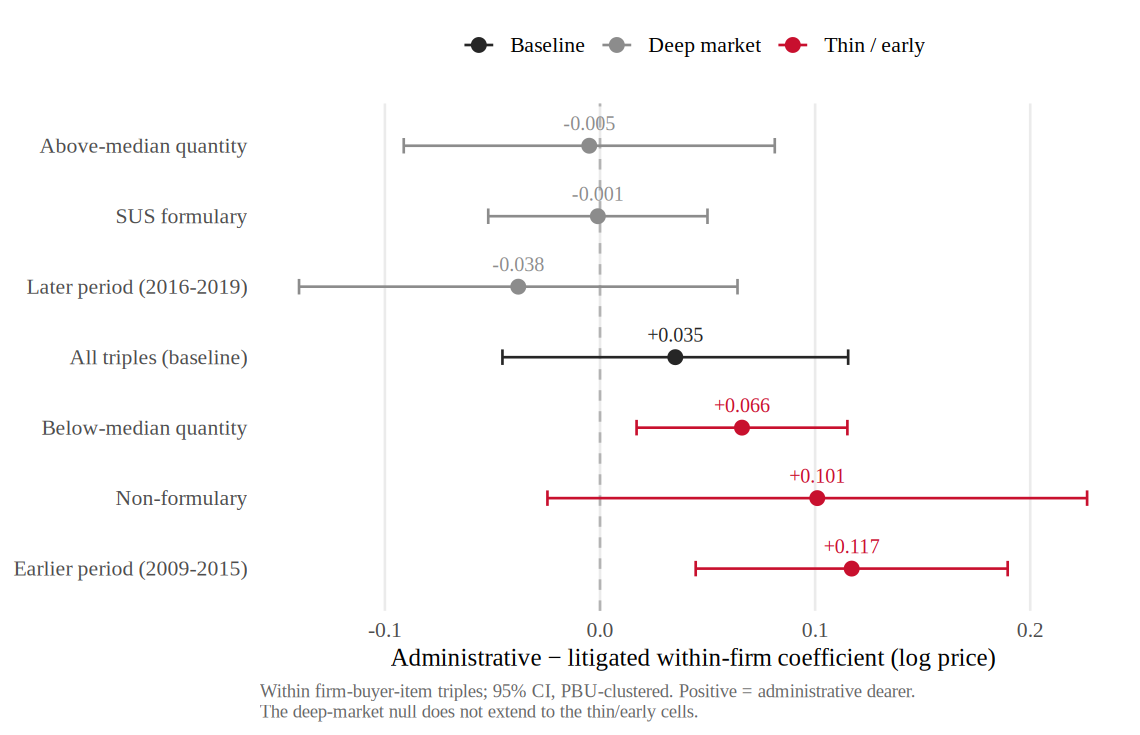
The same urgent purchase looks very different depending on how many suppliers can plausibly serve it. Where many firms compete and the item is a routine public-formulary molecule bought again and again, the litigation cost margin is small. Where the supplier pool is shallow or the molecule sits off the public formulary, the gap is larger. This page maps where the deep-market within-firm null breaks down — a diagnostic that locates the margin, not a fresh identification design. Read with AN-003, the disambiguation matters: the small-lot positive is scale and the surviving earlier-period gap is administrative-dearer, so the larger thin-market gap is not by itself evidence that a court order lets a supplier squeeze the litigated buyer.
Question
Does the litigated-urgent price gap concentrate in thin markets — off-formulary molecules and shallow supplier pools — locating where the deep-market within-firm null breaks down? This asks where the cost margin sits across the urgent panel, complementing the within-firm result in AN-003, which shows the same boundary along quantity, formulary, and period cuts — and disambiguates it (quantity = scale; the earlier-period gap is administrative-dearer).
Design
- Sample: the urgent panel, with the litigated-versus-administrative urgent log-price gap split by formulary status and market depth.
- Variation: litigated-urgent versus administrative-urgent within stratum, interacted with formulary status (SUS formulary versus non-formulary) and market-depth bins.
- Specification: the urgent gap interacted with formulary status and market-depth bins, with fixed effects and PBU clustering as in the within-firm and bounds specifications.
- Reading: diagnostic. It locates the cost margin across market types; it is not a separate identification design.
Results
| Market type | Urgent gap |
|---|---|
| Deep market, SUS-formulary | Small / near zero |
| Thin market, non-formulary | Larger |
UTG = litigated-versus-administrative urgent gap, split by formulary status and market depth. The detailed bins and coefficients are in the output table.
Output: v10-causal-mechanism/output/tables/tab_market_depth_heterogeneity.tex.
Interpretation
The litigated-urgent gap is larger where the supplier pool is shallow and where the molecule sits off the public (SUS) formulary. In deep, formulary markets — the markets that carry most of the urgent volume — the gap is small, mirroring the near-zero within-firm baseline in AN-003. In thin, off-formulary markets, the gap is larger. But locating the gap is not the same as labelling it: the disambiguation in AN-003 shows the quantity axis is scale (within-triple log-quantity −0.259), the surviving earlier-period gap is administrative-dearer rather than litigated-dearer, and the off-formulary positive is not statistically significant. This is the deep-market interpretation: the core paper result — that the cost margin is sourcing rather than a broad same-firm markup — holds where markets are deep and repeatedly traded, while the deep-market null is not universal at the thin-market and earlier-market edges. Whether that surviving edge is best called supplier leverage is left open rather than asserted.
Confidence: yellow. This is a diagnostic that locates the margin across market types, not a standalone identification design — it inherits the identification of the bounds and within-firm specifications and reads alongside them. The administrative urgent channel remains the selected, larger, closest feasible urgent-procurement comparison rather than a random or clean counterfactual. The reading is yellow because the evidence is single-jurisdiction (São Paulo BEC) and from own-project runs.
Follow-ups
- Tie the thin-market gap here to the within-firm quantity, formulary, and period splits — see AN-003.
- Connect deep-market depth to the lost-scale channel, since deep markets are where demand aggregation has the most to lose under fragmentation — see AN-005.
- Check whether the thin-market gap is driven by a narrow set of molecules or buyers via an aggregation-cell sensitivity — see AN-009.