AN-005: Pricing-vs-sourcing decomposition of the urgent gap
Economic intuition
The cost of court-mandated urgency could come from two very different places. Either the same supplier charges more (a pricing story), or the state ends up buying from a different, more fragmented set of suppliers in smaller lots (a sourcing story). This page does the arithmetic. Almost all of the observed cost gap is lost scale — administrative orders are about 3.3 times larger, and bigger orders earn bulk discounts. The same-firm pricing piece is essentially zero. What is left over points toward a change in who supplies, but that leftover is a reconciliation residual, so it has to be read together with the direct winner-switching evidence.
Question
How does the litigated-over-administrative urgent price gap split between same-firm pricing and supplier-set sourcing, and how much of it is lost scale? Court mandates secure delivery, but legal urgency changes how the state buys; this decomposition separates the channel that operates through the same firm's price from the channel that operates through the supplier set and the size of the order.
Design
- Sample: the urgent panel, decomposing the administrative-versus-litigated urgent comparison.
- Specification: a reconciliation of the administrative-minus-litigated log-price gap into three components — a quantity/scale component, a within-firm pricing component, and a supplier-composition residual — with a bulk-discount elasticity estimated alongside.
- Components reported (administrative-minus-litigated, %): observed gap, quantity/scale, within-firm pricing, supplier-composition residual.
Results
| Component | Value |
|---|---|
| Observed gap (admin minus litigated) | −22.8% |
| Quantity / scale | −32.8% |
| Within-firm pricing | +3.5% (near zero) |
| Supplier-composition residual | +10.9% |
Administrative orders are 3.3× larger than litigated urgent orders; estimated bulk-discount elasticity −0.329.
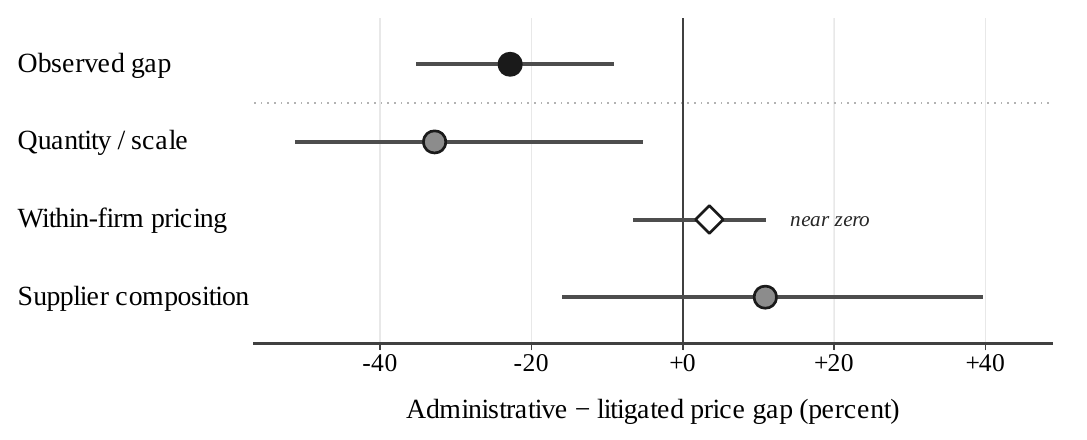
Output: v10-causal-mechanism/output/figures/fig_sourcing_vs_pricing.pdf (figure
regenerated by v10-causal-mechanism/analysis/47_regen_fig1.R).
Interpretation
The observed administrative-versus-litigated gap of −22.8% reconciles into three pieces. The dominant piece is lost scale: −32.8%, since administrative orders are about 3.3× larger and the estimated bulk-discount elasticity is −0.329, so fragmenting demand into smaller litigated orders forfeits volume discounts. The within-firm pricing piece is +3.5% — near zero, consistent with the no broad same-firm markup in deep repeated urgent markets result in AN-003. The supplier-composition residual is +10.9%, pointing toward a reallocation of the supplier set under litigation.
The residual is a reconciliation residual that balances the accounting identity — it is not standalone proof of sourcing. It must be read together with the direct winner-switching evidence in AN-006, which observes the supplier set moving between regimes. Read jointly, the picture is that in deep repeated urgent markets the cost margin is fragmented sourcing — lost scale plus supplier-set reallocation — rather than a broad same-firm markup.
Confidence: yellow. The decomposition is an accounting reconciliation, and its residual term carries the supplier-composition interpretation only in conjunction with AN-006. The administrative urgent channel is the selected, larger, closest feasible urgent-procurement comparison, not a random or clean counterfactual, so the scale gap partly reflects how the two channels are selected. The reading is yellow because the evidence is single-jurisdiction (São Paulo BEC) and from own-project runs.