AN-002: Lee bounds on the litigated-vs-administrative urgent gap
Economic intuition
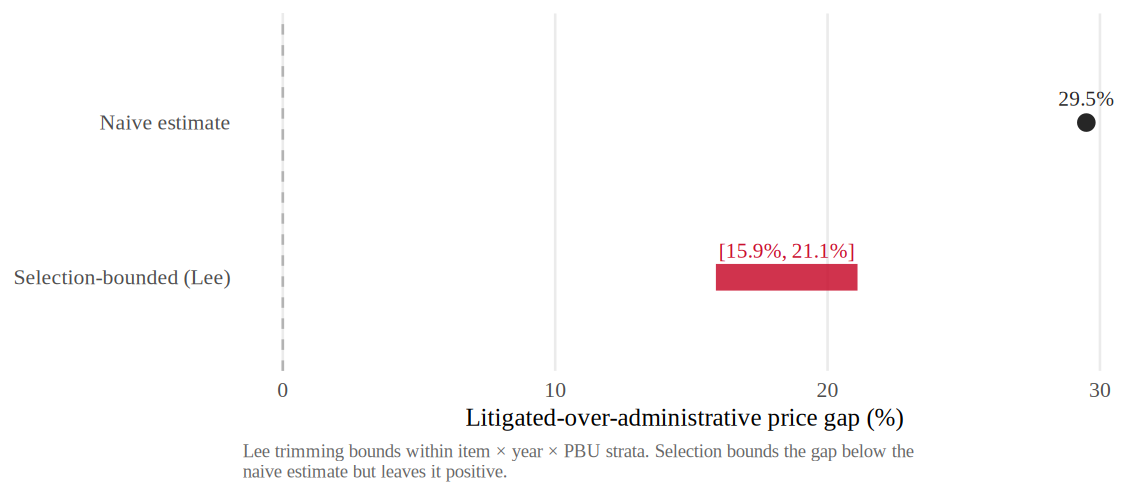
Among urgent purchases, the ones driven by a court order are not a clean random sample — different items, buyers, and circumstances reach the litigated channel than reach the administrative urgent channel, which is itself larger and selected. A raw comparison says the litigated channel costs about 29.5% more; but some of that gap could be who lands where, not the litigation itself. Lee bounds draw a worst-case box around that selection concern. The box still sits well above zero — 15.9% to 21.1% — so the cost premium survives even under conservative selection assumptions.
Question
Holding urgency fixed, how much more does the court-mandated (litigated) urgent channel cost than the closest administrative urgent comparison, once selection into litigation is bounded? The administrative urgent channel is the closest feasible urgent-procurement comparison — it is selected and larger, not a random or clean counterfactual. The question is whether the litigated-over- administrative price gap survives a worst-case treatment of that selection.
Design
- Sample: the urgent winner panel — 61,620 observations in the naive regression, 45,624 after Lee trimming — comparing administrative-urgent and litigated-urgent purchases within item×year×PBU strata.
- Variation: administrative-urgent versus litigated-urgent within stratum.
- Specification: Lee (2009) trimming bounds on the administrative-minus-litigated log-price coefficient, with trimming applied within item×year×PBU strata. Coefficients are administrative-minus-litigated log price, so a negative coefficient means the litigated channel is more expensive; percentages are reported as litigated-over-administrative.
- Robustness: alternative-strata trimming reported in
tab_utg_lee_alt_strata.tex. A parametric Heckman correction is non-informative here and is noted as such.
Results
| Quantity | Coefficient | Implied gap (litigated over administrative) | N |
|---|---|---|---|
| Naive (no trimming) | −0.259 (SE 0.092) | 29.5% | 61,620 |
| Lee lower bound | −0.148 | 15.9% | 45,624 |
| Lee upper bound | −0.192 | 21.1% | 45,624 |
| Bounded interval | — | 15.9% – 21.1% | — |
Trimming within item×year×PBU strata. Mean trimming proportion 26.9%, maximum 100%.
Output: v10-causal-mechanism/output/tables/tab_urgent_and_bounds.tex (Panel B) and
v10-causal-mechanism/output/tables/tab_utg_lee_alt_strata.tex.
Interpretation
The naive contrast puts the litigated urgent channel about 29.5% above the administrative urgent comparison. Bounding selection into litigation under monotonicity tightens the gap to a 15.9%–21.1% interval — lower than the naive figure, but well clear of zero. The mean trimming proportion is 26.9% (maximum 100% in some strata), so the trimming is substantial yet leaves a sizable premium intact. A parametric Heckman correction is non-informative in this setting and is reported only for completeness.
Confidence: yellow. The administrative urgent channel is selected and larger — the closest feasible urgent-procurement comparison rather than a random or clean counterfactual — so the Lee bounds discipline selection into the litigated channel under monotonicity; they do not eliminate it, and they leave other identification threats (cost shocks, item mix beyond the stratum) unaddressed. The reading is yellow because the evidence is from a single jurisdiction (São Paulo BEC) and own-project runs rather than independent replication.
Follow-ups
- Wild-cluster bootstrap inference on the bounded coefficient with few PBU clusters — see AN-007.
- A never-litigated placebo to probe whether the residual gap loads on litigation per se — see AN-008.
- Take the bounded price gap into the pricing-versus-sourcing decomposition to ask how much of it is same-firm pricing versus supplier-set reallocation — see AN-005.