Fragmented sourcing is the margin: lost scale and supplier-set reallocation
🟡 Decomposing the administrative-minus-litigated price gap shows that the cost of urgency operates through sourcing, not through same-firm pricing. Against an observed gap of −22.8%, the quantity/scale channel accounts for −32.8%, the within-firm component is +3.5% (near zero), and supplier composition contributes +10.9% as a reconciliation residual (AN-005, AN-009). Administrative orders are 3.3× larger than litigated ones, and the bulk elasticity of −0.329 turns that lost scale into a price penalty (AN-005).
Economic intuition
If price is up but the same firm is not charging more, the money has to be going somewhere else — and the decomposition says scale, while the supplier set says matching. Read the two together: the within-firm null closes the markup door, and the churn in winning suppliers (Jaccard overlap of just 0.268) opens the sourcing door. The composition term in the accounting is only a residual; the direct winner-switching evidence is what carries the reallocation claim.
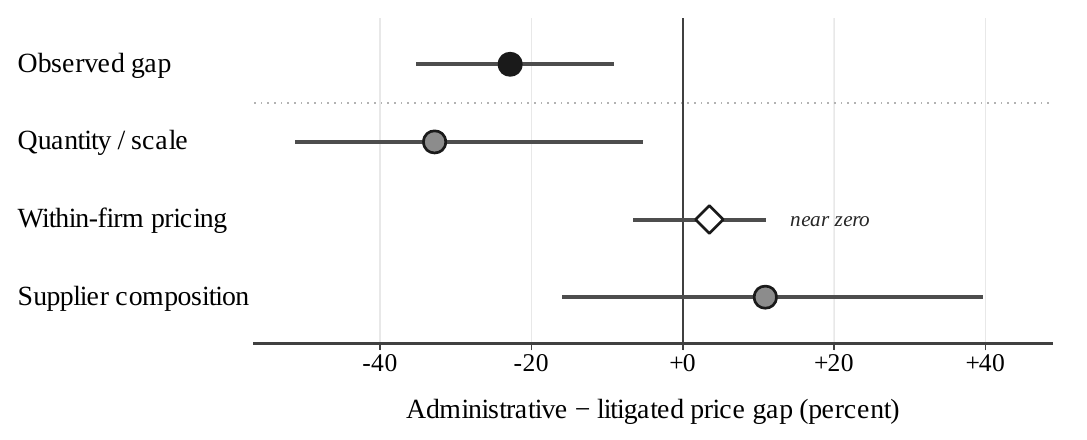
Decomposition of the administrative-minus-litigated price gap (fig_sourcing_vs_pricing_v10): the observed gap is dominated by the quantity/scale channel, the within-firm component sits near zero, and supplier composition enters as a reconciliation residual rather than a standalone channel.
The supplier-composition term is large but must be read with care: it is the reconciliation residual of the decomposition, not standalone proof of a reallocation effect, and should be interpreted alongside the direct winner-switching evidence. That evidence is substantial — across 2,134 item-buyer pairs, the supplier set used under litigation versus administration has a Jaccard overlap of only 0.268, 48.5% of pairs share no supplier at all, and the modal winner differs in 70.2% of pairs (AN-006). Lost scale and supplier-set reallocation, not incumbent markups, are where the urgency cost is concentrated.
Caveat. The decomposition is an accounting reconciliation of an observed gap into channels under maintained aggregation choices, not a structural counterfactual; the +10.9% supplier-composition term is a residual that absorbs whatever the quantity/scale and within-firm terms do not explain, so it is not a standalone reallocation estimate. The winner-switching statistics are descriptive comparisons of supplier sets, not causal demand-aggregation effects. The administrative channel here is the closest feasible urgent-procurement comparison, not a random benchmark. The reading is 🟡 because it is a single-source own-project estimate in São Paulo BEC.
Sources.
- Own analysis: AN-005 (price gap decomposition, order-size ratio, bulk elasticity), AN-006 (winner switching, Jaccard overlap, modal-winner differences), AN-009 (aggregation-cell construction).
- Cross-refs: H:lost-scale; H:supplier-set-reallocation.
- Validation: backing scripts
45_reconciliation.R,48_mechanism_evidence.R,50_v9_outputs.py.