H:urgent-costlier-less-competitive — Urgent procurement is costlier and less competitive than ordinary procurement
When the state must buy on a compressed deadline, the routines that build a thick bidding pool and aggregate demand have less time to work. The lot is smaller, fewer firms show up, and the negotiated price drifts up. This hypothesis establishes that the urgent environment itself is more expensive and thinner than ordinary pharmaceutical procurement. It is the motivational fact that frames the paper — it describes the terrain on which judicial urgency operates, but it is not the sanction-exposure design. The contrast between court-mandated urgency and the closest administrative urgent comparison is taken up separately in H:utg-gap-selection-bounded.
Economic intuition
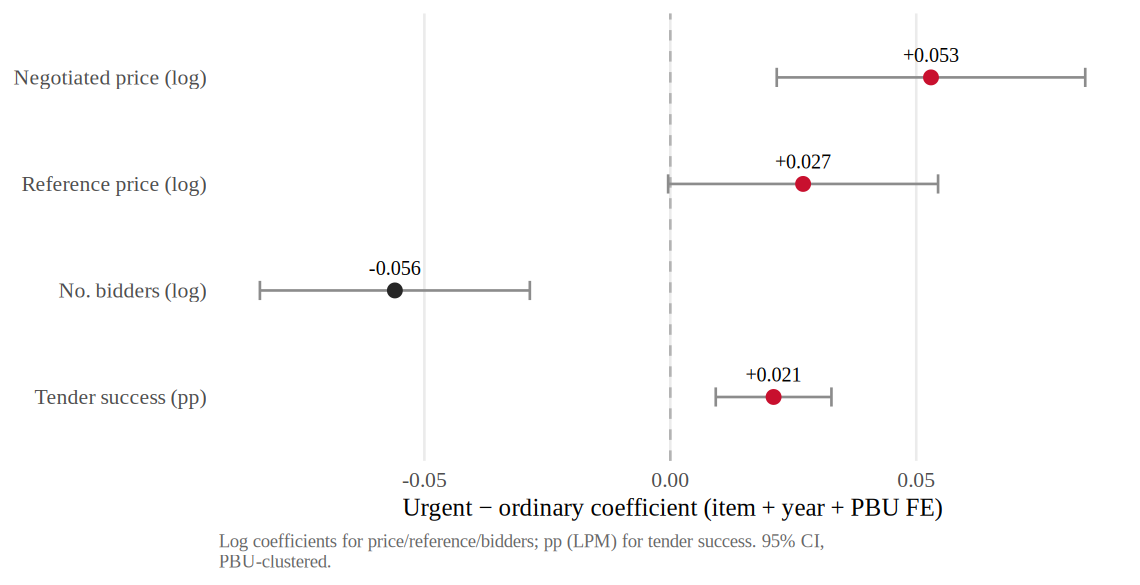
Buying in a hurry costs more. When a pharmaceutical purchase has to clear on a tight deadline, the state cannot wait for a deep field of bidders or batch the order into a large lot, so prices come in higher and fewer firms compete. We see this directly: urgent purchases run about 5.4% more expensive on the negotiated price, draw roughly 5.4% fewer bidders, and are slightly more likely to clear successfully. This sets the stage — it tells us the urgent environment is the costly one — but it does not yet isolate what the court sanction adds on top.
Evidence strength: Partial (strongly supported). AN-001 reports a log negotiated-price coefficient of 0.053 (SE 0.016), about +5.4%, alongside a log reference-price coefficient of 0.027 (SE 0.014, ≈ +2.7%), a log number-of-bidders coefficient of −0.056 (SE 0.014, ≈ 5.4% fewer bidders), and a tender-success coefficient of 0.021 (SE 0.006, ≈ +2.1pp). The pattern is consistent across the price and competition margins. This is a descriptive, motivational contrast and is read as such — the sanction-exposure identification lives in Cluster B.
Theory
Compressed procurement timelines limit the two margins that discipline price. First, they shorten the window for bidder entry, so the price-forming order statistic is drawn from a thinner pool — fewer competitors mean a higher expected winning bid. Second, urgency forecloses demand aggregation: the buyer cannot batch the requirement into a larger lot that would attract volume discounts. Both forces are central to the passive-waste view of public procurement (Bandiera, Prat & Valletti, 2009), in which slack in the buying process — not corruption — drives much of the price gap, and to the broader institutional account of procurement performance (Bosio et al., 2022; Best et al., 2023). Work on court efficiency and procurement (Coviello et al., 2018) likewise links time pressure on the contracting side to worse procurement outcomes.
Prediction
Within pharmaceutical procurement, urgent purchases should show, relative to ordinary purchases:
- a higher negotiated price (positive log-price coefficient);
- a higher reference price, but by less than the negotiated price (urgency shifts both the benchmark and the realized price);
- fewer bidders (negative log-bidder-count coefficient);
- a (weakly) higher tender-success rate, since urgent tenders are more likely to be pushed to completion under deadline pressure.
Competing prediction
Composition, not urgency. If urgent purchases simply happened to involve intrinsically more expensive molecules or harder-to-source items, the price gap would reflect what is bought rather than how fast. Under this view the gap should vanish once one conditions tightly on the item and the buyer. The within-item structure of the regressions and, more pointedly, the within-firm-buyer-item and never-litigated placebo analyses in Cluster B and Cluster D are what separate the urgency channel from pure composition; this motivational contrast does not by itself rule the composition story out.
Setting evidence
São Paulo's pharmaceutical procurement runs on the electronic BEC platform, which records bids at the offer level. Within the data, urgent demand is flagged distinctly from ordinary, scheduled procurement. Urgent purchases face the same auction procedures but compressed timelines and small quantities. The institutional account in docs/paper.md describes how urgency enters the procurement record and why it plausibly compresses both the entry window and lot size.
Empirical test
- Outcome variables: log negotiated price, log reference price, log number of bidders, and tender-success indicator.
- Variation: urgent vs ordinary pharmaceutical procurement within BEC group 65.
- Specification: item-level regression of each outcome on an urgent indicator with item and time controls and clustered standard errors.
- Sample: the winners-only price sample (196,883 bids) for price outcomes; the full purchase-offer-item universe (479,330 observations) for competition and success margins.
Data requirements and limitations
Requires the BEC parquet cache covering São Paulo group-65 pharmaceutical procurement, 2009–2019. The estimates are descriptive contrasts that establish the cost of the urgent environment; they do not, on their own, identify the effect of the court sanction, because urgent purchases differ from ordinary ones along many dimensions at once (timing, lot size, item mix). Treat this page as the motivation that the rest of the paper builds on, not as a causal claim about sanctions. The sanction-related margin is identified only by holding urgency fixed and bounding selection — see H:utg-gap-selection-bounded.
Evidence
| Analysis | Bearing | Key takeaway |
|---|---|---|
| AN-001 | Supports | Urgent vs ordinary: log negotiated price 0.053 (SE 0.016, ≈ +5.4%); log reference price 0.027 (SE 0.014, ≈ +2.7%); log #bidders −0.056 (SE 0.014, ≈ 5.4% fewer); tender success 0.021 (SE 0.006, ≈ +2.1pp). Establishes the costly, thinner urgent environment. |
Open tests
Decompose the urgent price gap into entry and lot-size channels
The motivational contrast bundles fewer bidders and smaller lots into a single urgent coefficient. A mediation-style split — how much of the +5.4% price gap runs through the −5.4% bidder margin versus the lot-size margin — would sharpen the link between this motivational fact and the lost-scale mechanism in H:lost-scale. It is descriptive and not load-bearing for the identification, but it would tie Cluster A to Cluster C more explicitly.
Item-mix sensitivity
Re-estimate the urgent contrast within finer therapeutic classes to gauge how much of the gap survives tighter composition controls, complementing the never-litigated placebo in AN-008.