AN-001: Urgent vs ordinary pharmaceutical procurement
Economic intuition
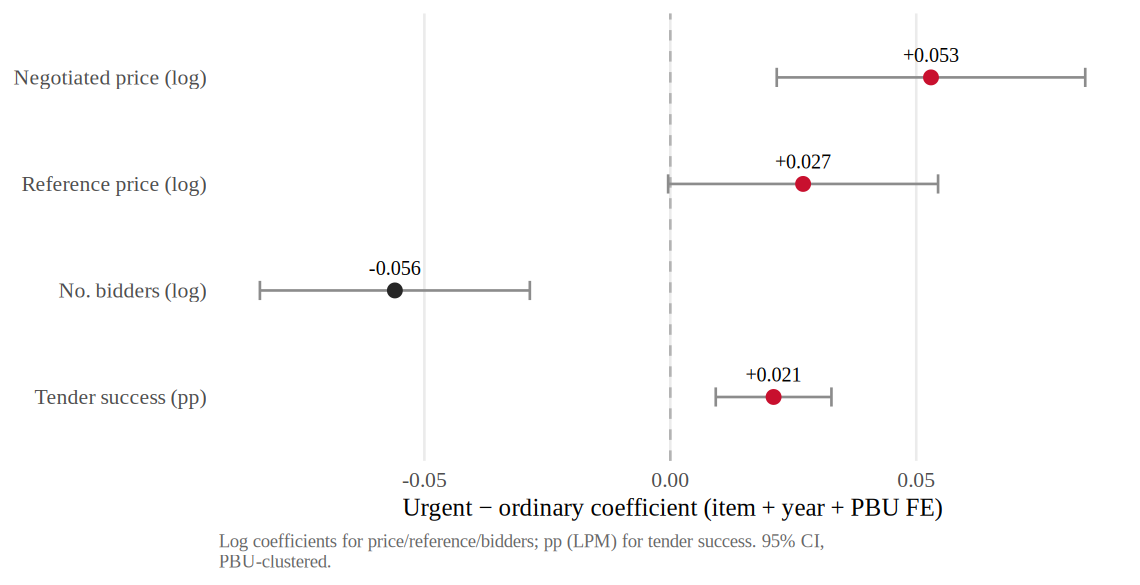
Buying in a hurry costs more. When a pharmaceutical purchase has to clear on a tight deadline, the state cannot wait for a deep field of bidders or batch the order into a large lot, so prices come in higher and fewer firms compete. Within the same item, year, and buyer, urgent purchases run about 5.4% more expensive on the negotiated price, draw roughly 5.4% fewer bidders, and are slightly more likely to clear. This sets the stage — it tells us the urgent environment is the costly one — but it is not yet the court-sanction design.
Question
Does urgent pharmaceutical procurement cost more and draw fewer bidders than ordinary procurement, holding the item, the year, and the purchasing buyer fixed? This is the motivational fact for the paper: it describes the terrain on which judicial urgency operates. It is not the sanction-exposure design — the court-mandated versus closest-administrative-urgent contrast is taken up in AN-002.
Design
- Sample: BEC group 65 São Paulo pharmaceutical procurement, 2009–2019. The winners-only price sample of 196,883 accepted winning bids drives the price outcomes; the 479,330-observation purchase-offer-item universe drives the competition and success margins.
- Variation: urgent versus ordinary procurement.
- Specification: item-level regression of each outcome on an urgent indicator, with item, year, and purchasing-buyer-unit (PBU) fixed effects. Standard errors are clustered by PBU.
- Outcomes: log negotiated price, log reference price, log number of bidders, tender-success indicator.
Results
| Outcome | Coefficient (SE) | Implied effect |
|---|---|---|
| Log negotiated price | 0.053 (0.016) | +5.4% |
| Log reference price | 0.027 (0.014) | +2.7% |
| Log number of bidders | −0.056 (0.014) | −5.4% |
| Tender success | 0.021 (0.006) | +2.1pp |
Item + year + PBU fixed effects. SE clustered by PBU.
Output: v10-causal-mechanism/output/tables/tab_urgent_and_bounds.tex (Panel A).
Interpretation
The urgent environment is the costly, thinner one. The negotiated price rises about 5.4% under urgency while the reference price rises by only about 2.7%, so urgency shifts the realized price by more than it shifts the benchmark. The bidder pool thins by roughly 5.4%, consistent with a compressed entry window, and urgent tenders clear about 2.1 percentage points more often, consistent with deadline pressure pushing tenders to completion. The pattern is coherent across the price and competition margins.
Confidence: yellow. This is a descriptive, motivational contrast read as such: urgent purchases differ from ordinary ones along several dimensions at once — timing, lot size, item mix — so the urgent coefficient bundles the urgency channel with composition. The within-item, within-year, within-buyer structure narrows the composition story but does not rule it out; that work is done by the within-firm-buyer-item analysis in AN-003 and the never-litigated placebo in AN-008. The reading is yellow throughout the paper because the evidence is from a single jurisdiction (São Paulo BEC) and own-project runs rather than independent replication.
Follow-ups
- Decompose the urgent price gap into the entry margin and the lot-size margin, tying this motivational fact to the lost-scale mechanism in AN-005.
- Re-estimate the urgent contrast within finer therapeutic classes to gauge how much of the gap survives tighter composition controls, complementing AN-008.
- Carry the urgent contrast into the court-sanction design, where urgency is held fixed and selection is bounded — see AN-002.