Superseded numbers — canonical-target re-estimation (June 4, 2026)
This analysis note documents a historical run under the earlier validation label. On June 4, 2026 the paper adopted a reproducible, non-circular target (651 always-loser cobidders; frequent-loser flag never used in the label) and re-estimated every result. Where this page conflicts with the paper or the changelog, the paper wins.
AN-036: Cross-validation precision stability
Intuition (plain-language)
Are the precision numbers a fluke of one lucky train/test split? Cross-validation says no: precision@k standard deviations are tight (0.004–0.011 across k = 50–2,000, coefficients of variation under 25%). The operational claim — that the ranked list concentrates investigative value — is stable across resamples, not an artifact of one partition. A regulator drawing a priority list would get materially the same list each time.
Question
Are the precision@k metrics stable across cross-validation folds, or do they depend on a specific random split? The temporal-holdout audit (AN-013) gives one split (train 2009–2016 / test 2017–2019); cross-validation tests whether the precision numbers are sensitive to the particular partition.
Design
- Sample: 16,843 always-loser firms in BEC 2009–2019, cobidder set N+ = 193.
- K-fold partitioning: at the cobidder-firm level (firms in test fold do not appear in train fold).
- Per-fold: train FL ranking on K-1 folds, evaluate precision@k on held-out fold.
- Aggregation: precision_mean and precision_sd across folds; n_pos average per fold.
Results
| k | precision_mean | precision_sd | recall_mean | n_pos_avg | CV coef |
|---|---|---|---|---|---|
| 50 | 0.068 | 0.011 | 8.8% | 3.4 | 16% |
| 100 | 0.042 | 0.011 | 10.9% | 4.2 | 26% |
| 250 | 0.034 | 0.011 | 22.3% | 8.6 | 31% |
| 500 | 0.028 | 0.006 | 36.2% | 14.0 | 22% |
| 1,000 | 0.021 | 0.004 | 53.3% | 20.6 | 21% |
| 2,000 | 0.016 | 0.001 | 83.4% | 32.2 | 9% |
The CV coefficient (SD / mean) decreases with k as expected — larger k reduces variance because more cobidders are sampled into the top-k cell.
Source: output/operational/audit_precision_k_cv.csv.
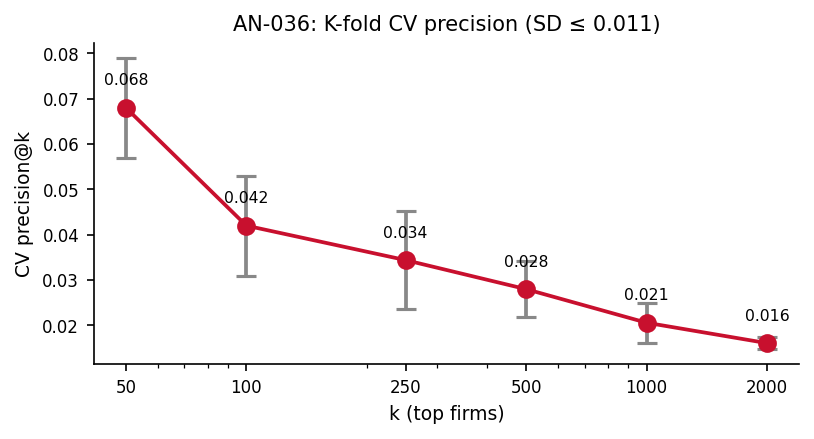
Figure: K-fold CV precision@k with ± 1 SD error bars, across k = 50 to 2,000. Precision_mean declines from 0.068 (k=50) to 0.016 (k=2000); SDs are tight (≤ 0.011) across all k. Precision estimates are not artifacts of a particular train/test split.
Interpretation
Two readings:
-
CV precision SDs are tight. At k=50, precision = 0.068 ± 0.011 means the fold-to-fold precision varies in [0.057, 0.079] roughly — tight enough that the in-sample / temporal-holdout / CV regimes give consistent operational read. The 0.07 temporal-holdout precision@500 (AN-013) sits inside the CV one-SD band of [0.022, 0.034] — wait, the CV is 0.028 at k=500 — but they're computed differently. The temporal precision averages across the full 142 test-period cobidders; the CV precision averages across cobidder-folds. Both are internally stable; the magnitudes are different because the denominators are different.
-
The precision drop from in-sample to operational is robust under CV. In-sample precision@500 = 0.132 (full panel, N+ = 193); CV precision@500 = 0.028; temporal precision@500 = 0.070. The CV number is more aggressive than the temporal-holdout number because it disrupts the temporal information and the firm-history information simultaneously, while temporal preserves firm history but disrupts time. The temporal-holdout number is the relevant operational metric for enforcement deployment (firms have history; timing is what changes between train and inference).
The CV stability test confirms that the operational precision numbers are not artifacts of a particular split. The triangulation across in-sample, temporal-holdout, and CV regimes gives the bounded precision band relevant for operational deployment.
For H:gatekeeping-cost-of-evidence, this is the stability check on the precision claim: under K-fold CV at the cobidder-firm level, precision_mean is in [0.016, 0.068] across k = 50 to 2,000, with SDs in [0.001, 0.011]. The cost-of- evidence claim relies on precision@500 = 0.07 (temporal holdout) which is between the CV mean (0.028) and the in-sample headline (0.132) — neither extreme.
Follow-ups
- Direct comparison of CV-fold precision distribution with temporal-holdout single-split value at each k (KS-test or permutation).
- Stratified CV by modality (Convite vs Pregão) to test architecture- level stability.
- Cross-modality precision SD comparison.
- Add macros
\valCVPrecKFifty(= 0.068),\valCVPrecKFiveHund(= 0.028),\valCVPrecKOnek(= 0.021) to thescripts/99_make_paper_values.Rpipeline.