Superseded numbers — canonical-target re-estimation (June 4, 2026)
This analysis note documents a historical run under the earlier validation label. On June 4, 2026 the paper adopted a reproducible, non-circular target (651 always-loser cobidders; frequent-loser flag never used in the label) and re-estimated every result. Where this page conflicts with the paper or the changelog, the paper wins.
AN-025: Cutoff-sweep robustness (FL2 through FL100)
Intuition (plain-language)
Sweep the cutoff from FL2 to FL100 and watch discrimination. It traces a clean inverted-U: rising to a peak around FL13 (0.924), then sliding as the cutoff gets so high it starts excluding the cobidders themselves. The FL10–FL15 band all clears 0.90. Economically this is the reassuring picture — the signal lives on a broad plateau, so FL14 is a point on a hill, not a needle balanced on a spike.
Question
How does cobidder AUC vary as the FL cutoff sweeps from FL2 through FL100, and is FL14 picking up an arbitrary plateau or a peak? The sweep documents the full robustness profile that would be hidden by reporting only the headline FL14 number.
Design
- Sample: 16,843 always-loser firms in BEC 2009–2019.
- Positive class: 193 cobidders (AN-003).
- Sweep: cutoff
tenders_count > kfor k ∈ {2, 3, 5, 6, 7, 8, 9, 10, 11, 12, 13, 14, 15, 16, 17, 18, 19, 20, 21, 22, 23, 30, 50, 75, 100}. - At each cutoff: AUC, N firms above cutoff, N CADE cobidders above cutoff (the latter measures whether cobidders get "cut off" themselves at tighter thresholds).
Results
Selected cutoffs from the full sweep (source CSV has 19+ rows):
| Cutoff (k) | AUC | N above cutoff | N cobidders above |
|---|---|---|---|
| 2 | 0.730 | 9,186 | 193 |
| 5 | 0.833 | 5,757 | 193 |
| 7 | 0.868 | 4,574 | 193 |
| 10 | 0.902 | 3,442 | 193 |
| 13 (≡ paper FL14, ≥ 14) | 0.924 | 2,735 | 193 |
| 14 (≡ FL15, > 14) | 0.911 | 2,537 | 186 |
| 15 | 0.884 | 2,385 | 174 |
| 18 | 0.834 | 1,981 | 150 |
| 20 | 0.824 | 1,778 | 144 |
| 30 | 0.744 | 1,118 | (declining) |
| 50 | 0.662 | 545 | (declining) |
| 100 | 0.568 | 163 | (declining) |
Source: output/continuous_vs_binary/auc_threshold_sweep.csv.
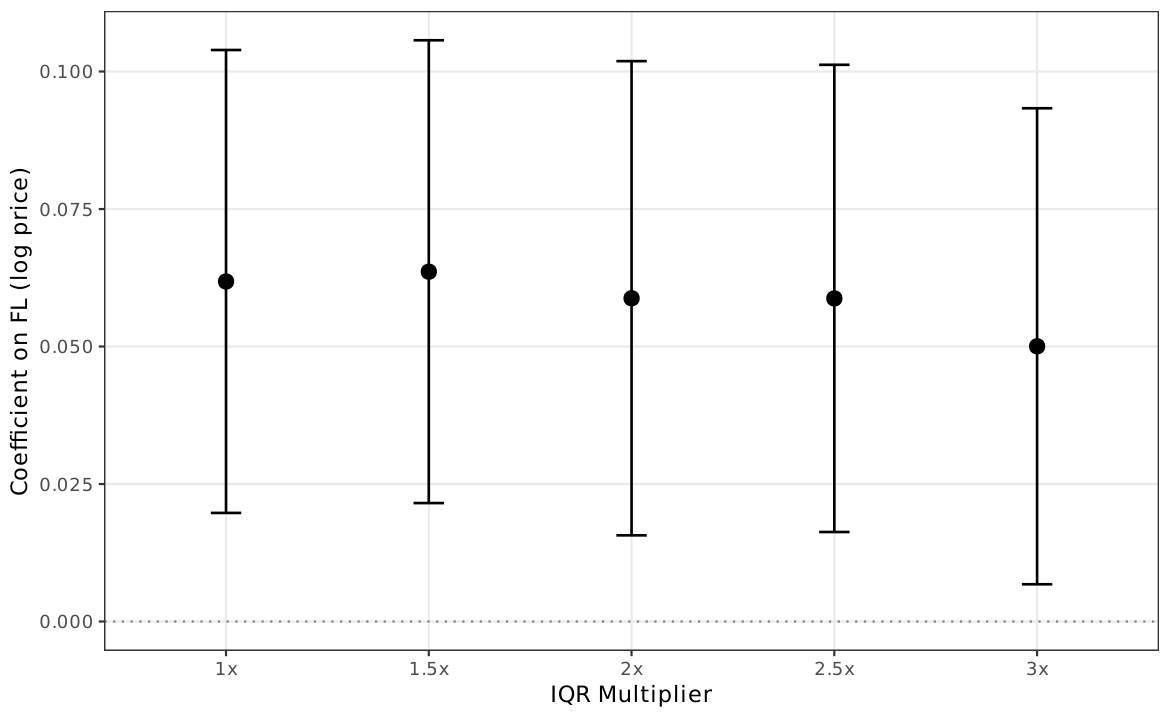
Figure: AUC as a function of the FL cutoff value k, for cobidder discrimination. The shape is a clean inverted U: rising from k=2 to peak at k=13 (AUC 0.924), declining smoothly afterward. The FL10–FL15 plateau is ≥ 0.90; the FL14 paper choice sits on the high plateau, not at a fragile peak.
The shape is a clean inverted U:
- Rising branch (k = 2 → 13): AUC rises monotonically from 0.730 to 0.924. Tighter cutoffs progressively concentrate the cobidder signal.
- Peak: k = 13 (AUC = 0.924). This is one tender below the IQR
threshold statistic (
\valThresholdStat= 13.5, rounded to 14). - Plateau (k = 10–14): AUC = 0.902–0.924 across five consecutive cutoffs. The FL14 choice sits on the high plateau, not at a fragile peak.
- Falling branch (k = 15 → 100): AUC falls from 0.884 toward 0.57 as the cutoff tightens past the point where cobidders themselves get excluded (N cobidders above cutoff drops from 193 at k=13 to 144 at k=20 to <50 at k=100).
Interpretation
The sweep accomplishes three things:
-
Plateau confirms the paper's choice is not arbitrary. The median + 1.5 × IQR rule lands at k = 14 (statistic = 13.5), which is one bucket off the empirical AUC peak of k = 13 (0.924). The FL14 cutoff is auditable (median + 1.5 × IQR is a textbook quantile rule) and sits at the top of a wide plateau. A reviewer asking "why this specific cutoff?" is answered: any cutoff in the FL10– FL15 range gives AUC > 0.90.
-
Falling branch shows the construct has the right shape. If the FL signal were spurious, tighter cutoffs would not produce monotonically smaller AUC after the peak. The clean inverted-U is what one would expect under the loser-side cover-bidding interpretation: too-loose cutoffs include many non-cobidder always-losers (false positives); too-tight cutoffs exclude the cobidders themselves (false negatives at the construct level — the N cobidders above cutoff column shows this directly).
-
FL14 (≥ 14) is administrative, not a structural optimum. Because the sweep indexes cutoffs as
> k, the paper's ≥ 14 rule is the> 13row: AUC 0.924, 2,735 firms, 193 cobidders — matching the headline AUC in AN-004. It happens to sit near the top of the plateau, but the paper does not select FL14 because it is the AUC peak — it is fixed ex ante by the median + 1.5·IQR administrative rule. The economic object is the continuous loser-side rank (AN-011, AN-023); FL14 is the auditable deployable layer on top of it. The sweep is a robustness frontier, not a search for an optimal cutoff.
This is the robustness check that converts H1 from "single-cutoff result" to "robust across a wide cutoff band". See H:cobidder-concentration.
Follow-ups
- Same sweep on temporal-holdout sample (the inverted U should retain shape but with depressed levels — interaction with AN-013).
- Sweep on the strict-train pool of AN-006.
- Add macros
\valAUCSweepK10,\valAUCSweepK13,\valAUCSweepK14,\valAUCSweepK20to thescripts/99_make_paper_values.Rpipeline so that the sweep numbers enter values.tex on the next refresh.