Superseded numbers — canonical-target re-estimation (June 4, 2026)
This analysis note documents a historical run under the earlier validation label. On June 4, 2026 the paper adopted a reproducible, non-circular target (651 always-loser cobidders; frequent-loser flag never used in the label) and re-estimated every result. Where this page conflicts with the paper or the changelog, the paper wins.
AN-002: IQR threshold and FL14 cutoff stability
Intuition (plain-language)
Where does "a few losses" end and "frequent loser" begin? Drawing the line by hand invites cherry-picking, so the paper fixes it with a mechanical quantile rule (median + 1.5 × IQR → FL14, 2,735 firms). The economic question is whether the signal is fragile at that line. It is not: discrimination sits at AUC 0.924 on a wide plateau, and the tighter Tukey cutoff (1,981 firms) actually loses power (0.834). The rule is defensible precisely because the result does not hinge on the exact threshold — the underlying object is continuous loser-side concentration, not a magic number.
Question
How does the cobidder AUC change as the IQR threshold is varied, and is
the median + 1.5 × IQR cutoff distinguishable from alternatives? The
paper deliberately uses median + 1.5 × IQR, not the standard Tukey
Q3 + 1.5 × IQR.
Design
- Sample: always-loser firms in BEC 2009–2019 (16,843 firms).
- Alternative cutoffs evaluated:
- Paper convention: median + 1.5 × IQR (FL14; integer cutoff = 14; 2,735 firms);
- Tukey: Q3 + 1.5 × IQR (1,981 firms);
- Continuous: log(1 + tenders_count) (no cutoff).
- Outcome: AUC against the cobidder set (AN-003).
Results
| Cutoff rule | N firms above cutoff | AUC | 95% CI |
|---|---|---|---|
| FL14 (median + 1.5 × IQR — paper) | 2,735 | 0.924 | [0.921, 0.926] |
| Tukey Q3 + 1.5 × IQR | 1,981 | 0.834 | [0.804, 0.863] |
| Continuous log(1 + tenders_count) | — | 0.939 | [0.932, 0.946] |
Output: output/threshold_table_q3iqr/threshold_table_q3iqr.csv. Macros:
\valAUCFLfirm (FL14), \valAUCQThreeIQR (Tukey),
\valAUClogtc (continuous).
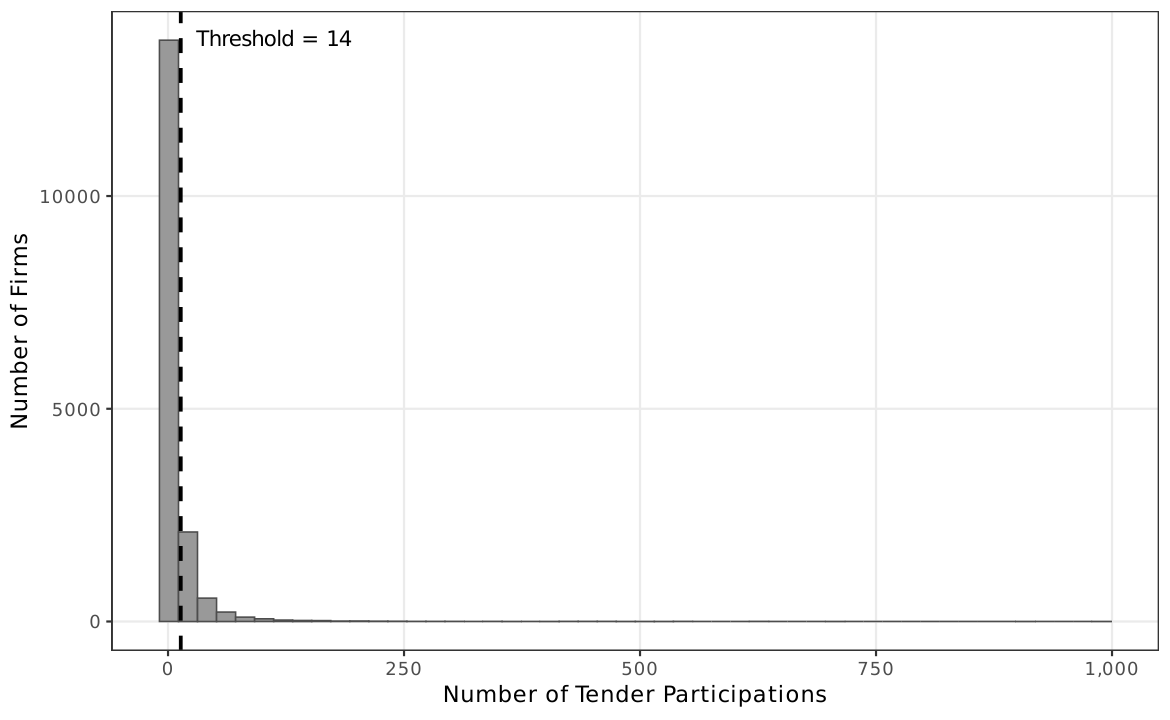
Figure: the FL14 cutoff (median + 1.5 × IQR = 13.5) plotted against the tenders_count distribution. The Tukey alternative (Q3 + 1.5 × IQR) is also marked for reference. The paper's choice sits between the naive median and the conservative Tukey rule.
Interpretation
The paper's median + 1.5 × IQR cutoff (FL14) sits between the very tight Tukey rule and the continuous score. The auditable binary loses ~0.015 in AUC relative to the continuous score, and the tighter Tukey rule loses ~0.09. The choice of FL14 is a deliberate operational trade-off: auditable, easy to monitor, but not the maximum-discrimination specification. The continuous score is documented in AN-011 and AN-017 as the dominating informational primitive.