Superseded numbers — canonical-target re-estimation (June 4, 2026)
This analysis note documents a historical run under the earlier validation label. On June 4, 2026 the paper adopted a reproducible, non-circular target (651 always-loser cobidders; frequent-loser flag never used in the label) and re-estimated every result. Where this page conflicts with the paper or the changelog, the paper wins.
AN-016: Gate D2 — modal-by-modal AUC
Intuition (plain-language)
D2 asks where the screen bites harder: Convite (sealed-bid, with a minimum-bidder rule) or Pregão (open electronic auction). A tempting institutional theory predicted Convite — the minimum-bidder rule should force cartels to field more cover bidders. The data say the opposite (continuous AUC Pregão 0.95 vs Convite 0.82), which killed an alternative framing of the paper. The disciplined reading: this is scope information about where the footprint is strongest, not evidence that an institutional rule identifies the mechanism.
Question
D2 gate diagnostic: does the FL screen discriminate cobidders better in Convite (sealed-bid, minimum-bidder rule) or in Pregão (electronic auction, no minimum-bidder rule) environments? The institutional theory behind a hypothetical γ++ winner/loser reframing predicted Convite > Pregão: under the minimum-bidder rule, cartels need more cobidders to manufacture the appearance of competition, so the loser-side footprint should be larger and the FL signal stronger in Convite.
Design
- Sample: cobidders split by procurement modality:
- convite_primary: cobidders primarily active in Convite tenders;
- pregão_primary: cobidders primarily active in Pregão tenders.
- Specification: AUC by modality for FL14 (binary) and continuous log_tc; bootstrap CI on the AUC difference.
- Caveat: convite_primary has only 6 cobidders (small N+), so Convite-specific results are statistically thin.
Results
| Modality | FL14 AUC | FL14 CI | log_tc AUC | log_tc CI |
|---|---|---|---|---|
| convite_primary | 0.865 | [0.857, 0.873] | 0.816 | [0.758, 0.874] |
| pregão_primary | 0.924 | [0.910, 0.938] | 0.952 | [0.946, 0.958] |
Bootstrap difference (continuous, pregão − convite): −0.136, p ≈ 0.
External-validity cross-check (script 52):
\valExtConvAUC = 0.816, \valExtPregAUC = 0.952.
Macros: \valAUCConvFL, \valAUCConvlogtc, \valAUCPregFL,
\valAUCPreglogtc, \valExtConvAUC, \valExtPregAUC.
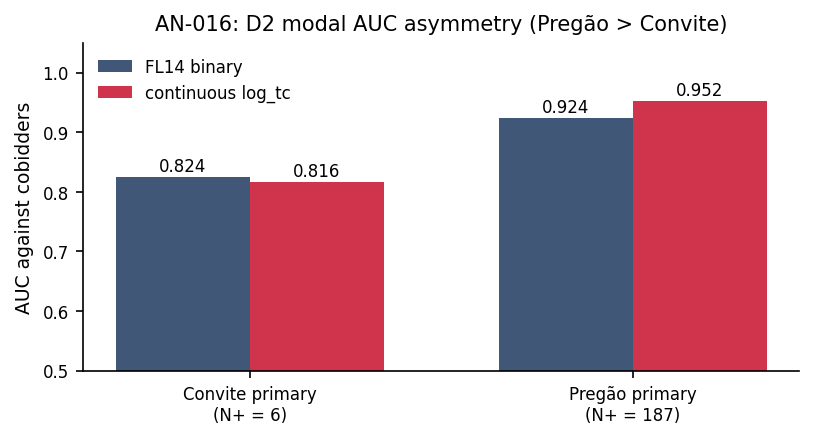
Figure: AUC against cobidders by modality. Pregão (no minimum-bidder rule) dominates: FL14 0.924, continuous 0.952. Convite (minimum-bidder rule) lower: FL14 0.865, continuous 0.816. Direction is OPPOSITE to the institutional theory — interpreted as scope information, not institutional positive test.
Interpretation
Direction is OPPOSITE to the institutional minimum-bidder-rule theory. The screen discriminates better in Pregão (no minimum-bidder rule) than in Convite (minimum-bidder rule). This formally disqualifies the γ++ winner/loser reframing that would have required the opposite direction for its institutional argument to hold.
Framing (mr-frequent locked rule): present D2 as "the construct discriminates better in Pregão environments; we interpret this as scope information, not as institutional identification" — NOT as a positive test of the minimum-bidder-rule theory. This framing aligns with H:price-scope-sign-reversal.
The Convite cell is small (6 cobidders) and its CI is wide; the asymmetry is statistically robust because the Pregão cell is large and tight, not because the Convite cell is precise.
This result locked the JLEO path on 2026-04-30 and prevented a 4-week detour into a salvage narrative that the data did not support.
Follow-ups
- Diagnostic on the small-N Convite stratum (exact tests, power).
- Sub-period stability of the modal asymmetry.
- Triangulation with the falsification Pregão-only result (AN-022).