Superseded numbers — canonical-target re-estimation (June 4, 2026)
This analysis note documents a historical run under the earlier validation label. On June 4, 2026 the paper adopted a reproducible, non-circular target (651 always-loser cobidders; frequent-loser flag never used in the label) and re-estimated every result. Where this page conflicts with the paper or the changelog, the paper wins.
AN-001: Persistent zero-win participation rank
Intuition (plain-language)
A cartel that rigs a tender still has to make the auction look competitive, or the buyer rejects it for too few bidders. The cheapest way to manufacture that appearance is to field firms that bid but are never meant to win. Over a decade those designated losers accumulate a distinctive footprint: many appearances, zero awards. Of the ~16,800 firms that never won between 2009 and 2019, the IQR rule isolates the 2,735 that bid far more often than a genuine also-ran ever would. The hypothesis is simple: for a cover bidder, frequent losing is not bad luck — it is the job.
Question
How is the persistent-zero-win-participation rank constructed, and what is its distribution across always-loser firms in BEC 2009–2019? The rank is the empirical primitive of the paper's award-layer triage.
Design
- Sample: 16,843 always-loser firms (
win_rate == 0) in the BEC LANCES panel Jan 2009 – Dec 2019. The always-loser pool is constructed out of the full BEC firm registry of 41,444 firms. - Continuous score:
log(1 + tenders_count). Monotone, not classificatory; carries the full information. - Binary rule (FL14):
1iftenders_count > 13.5(the IQR threshold statistic). The integer cutoff of 14 is the auditable implementation. - Identification: the rank is the empirical primitive; binary and continuous variants are documented side by side in AN-002 and AN-011.
Results
| Quantity | Value |
|---|---|
| BEC firms total | 41,444 |
| Always-loser firms | 16,843 |
| IQR threshold statistic (median + 1.5 × IQR) | 13.5 |
| FL14 binary cutoff (integer) | 14 |
| FL14 firms | 2,735 |
| FL14 share of always-losers | 16.2% |
| Cobidders inside FL14 / share | 7.1% |
Output: data/processed/firm_loss_stats.parquet. The macro pipeline
(values.tex) carries the canonical figures via
\valAlwaysLosers, \valFL, \valBECfirms, \valThreshold,
\valThresholdStat, \valFLrateAL, \valCobidShareFL.
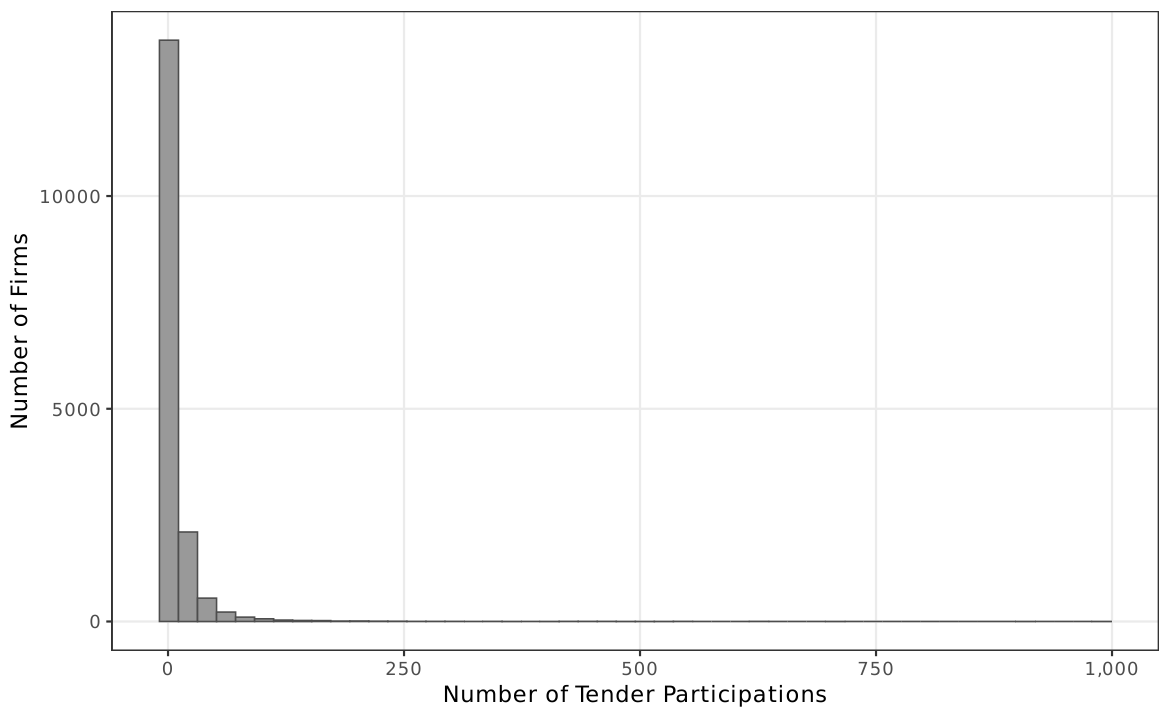
Figure: distribution of tenders_count among the 16,843 always-loser
firms. The median + 1.5 × IQR threshold (= 13.5, rounded to 14) is the
FL14 cutoff used in the paper. The long right tail selects the 2,735
FL14 firms.
Interpretation
The rank is small, transparent, and auditable. The IQR cutoff produces a sharp binary rule (FL14) that selects roughly one in six always-losers, which is consistent with the paper's framing of FL14 as a deployable operational rule on top of an underlying continuous score. The 7.1% cobidder share inside FL14 is the raw concentration that the downstream audits and benchmarks discipline.