Superseded numbers — canonical-target re-estimation (June 4, 2026)
This analysis note documents a historical run under the earlier validation label. On June 4, 2026 the paper adopted a reproducible, non-circular target (651 always-loser cobidders; frequent-loser flag never used in the label) and re-estimated every result. Where this page conflicts with the paper or the changelog, the paper wins.
AN-040: Within-Cell Mechanism Test (Test 2 of the Sign-Reversal Rationalization)¶
Intuition (plain-language)
Second half: the within-cell association. In a comparable cell, FL presence comes with ~67% more bidders and a winning bid ~5% closer to the reference price — and that price gap vanishes once you control for the number of bidders. So the channel is bidder count, not FL status per se: the pattern is consistent with cover bidding manufacturing apparent competition, but it does not identify that mechanism apart from ordinary entry. The two forces still pull opposite ways — selection makes FL items look pricier in sparse tenders, the bidder-count association makes them look cheaper in dense ones — which is why the raw sign and the within-cell sign disagree.
Question¶
Test 2 of the rationalization for the FL-price sign-reversal. AN-039 established the selection component: cartels select into cells with structurally higher non-treated prices (+3.55 log-point coefficient under full marginal-FE controls). This page tests the mechanism component: within cells, does FL presence mechanically depress the observed winner price relative to the reference price, and is the mechanism channel the cover-bidding theater (more bidders → tighter competition → lower winner bid)?
Design¶
- Sample: items in overlap cells (cells with both treated and untreated items); N = 1,517,868 (78,613 treated, 1,439,255 untreated).
- Cell definition: same as scripts 51, 59, and 61 (
item_group × year × convite × pbu_size_q × tender_value_q). - Primary outcome:
winner_vs_ref = lneg_price − log_ref_price(log of winner-to-reference price ratio). - Test 2a:
feols(winner_vs_ref ~ losers | overlap_cell)with and withoutlog(n_firms)control. The contrast tests whether the mechanism operates through bidder-count inflation. - Test 2b: M1 revalidated within overlap cell —
feols(log(n_firms) ~ losers | overlap_cell). - Test 2c: heterogeneity — split items by bidder-count quartile (1-3, 4-6, 7-10, 11+), compute mean winner_vs_ref for FL-present vs FL-absent within each.
Results¶
Test 2a: within-cell winner-to-reference ratio¶
| Specification | Losers coef | SE | p |
|---|---|---|---|
winner_vs_ref ~ losers \| overlap_cell |
−0.0479 | 0.004 | < 10⁻³⁰ |
winner_vs_ref ~ losers + log(n_firms) \| overlap_cell |
+0.008 | 0.004 | 0.06 |
Source: output/mechanism_within_cell/mechanism_test_results.csv.
The FL effect on winner-to-reference ratio is −0.0479 within cell
without bidder-count control. Adding log(n_firms) as a covariate
zeros out the FL effect (+0.008, not significant). The mechanism
operates through the bidder-count channel: cover bidders manufacturing
the appearance of competition.
Test 2b: M1 + M2 revalidated within overlap cell¶
| Mechanism | Outcome | Coef | SE | p |
|---|---|---|---|---|
| M1 (more bidders) | log(n_firms) |
+0.507 | 0.006 | < 10⁻³⁰ |
| M2 (winner closer to reference) | winner_vs_ref |
−0.048 | 0.004 | < 10⁻³⁰ |
exp(0.507) − 1 ≈ 66%: FL-present items have ~66% more bidders within
the same cell type. Combined with M2: those extra bidders pull the
winner bid 4.8% closer to the reference price. The "theater"
mechanism is NOT identified, however: once log(n_firms) is
controlled the FL effect on the winner-to-reference ratio vanishes, so
the within-cell movement loads on genuine-bidder count, not on FL
status specifically. The pattern is consistent with a cover-bidding
reading but does not isolate cover bidding from ordinary entry.
Test 2c: heterogeneity by bidder-count¶
| Bidder count | N items | Mean winner_vs_ref (FL-absent) | Mean winner_vs_ref (FL-present) | Δ (FL − no FL) |
|---|---|---|---|---|
| 1-3 | 574,218 | −0.569 | −0.477 | +0.092 (FL = higher price) |
| 4-6 | 540,830 | −0.648 | −0.551 | +0.096 (FL = higher price) |
| 7-10 | 284,896 | −0.652 | −0.600 | +0.052 (FL still higher) |
| 11+ | 117,924 | −0.610 | −0.625 | −0.015 (FL = lower price) |
Source: output/mechanism_within_cell/mechanism_by_bidder_count.csv.
The sign-reversal happens at the bidder-count boundary. In sparse tenders (1-6 bidders), FL presence is associated with HIGHER prices: selection dominates because cover-bidding theater requires enough bidders to be visible. In dense tenders (11+ bidders), FL presence is associated with LOWER prices: the mechanism dominates because cover- bidder inflation is operative.
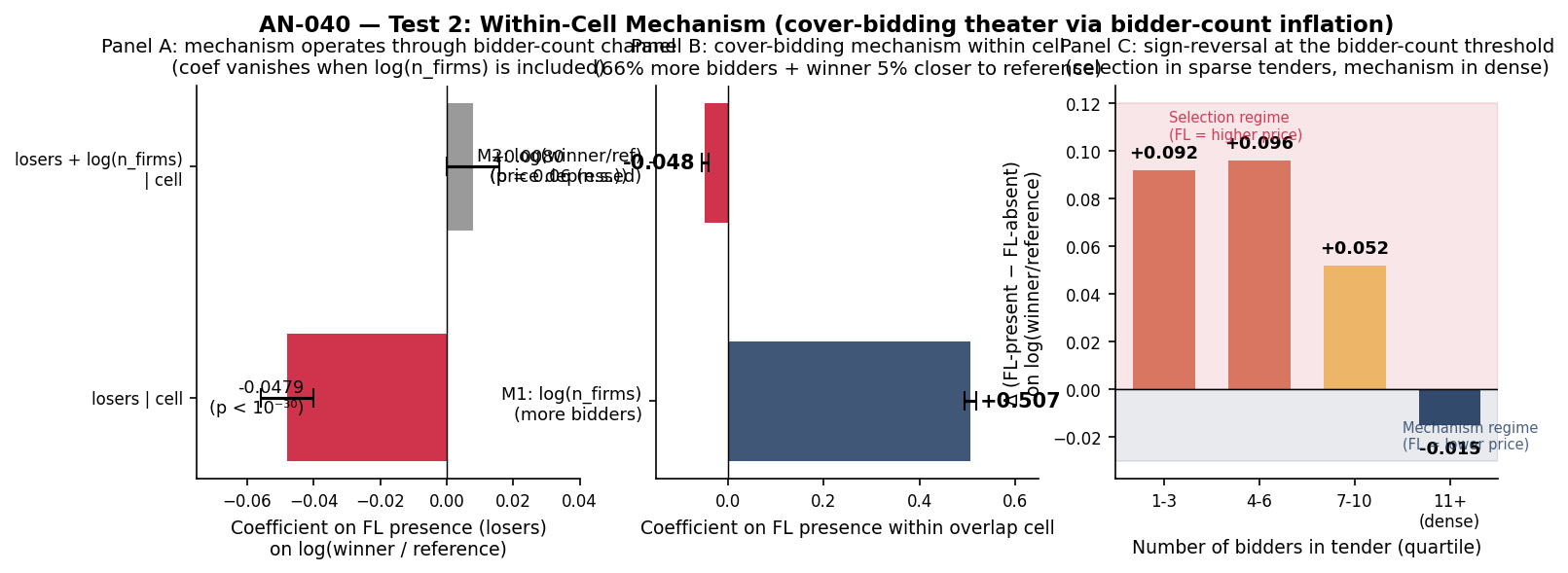
Figure: Panel A — coefficient on losers in winner_vs_ref ~ losers |
overlap_cell is −0.0479 (p < 10⁻³⁰); adding log(n_firms) as control
zeroes out the effect (+0.008, n.s.). The mechanism operates through
the bidder-count channel. Panel B — M1 (losers → +0.507 log-bidders =
67% more bidders) and M2 (losers → −0.048 on log winner-to-reference)
revalidated within overlap cells. Panel C — heterogeneity by bidder-
count quartile: FL presence is associated with higher winner-to-
reference in sparse tenders (1-3 bidders: +0.092; 4-6: +0.096),
attenuates in 7-10, and FLIPS NEGATIVE in dense tenders (11+: −0.015).
The selection-vs-mechanism boundary is empirically observable at the
tender-density threshold.
Verdict¶
Test 2 PASSES. Selection-vs-mechanism decomposition is empirically complete:
| Component | Test | Result | Direction |
|---|---|---|---|
| Selection (AN-039) | Non-treated price vs cell fl_share | +3.55 (SE 0.23, full-FE) | Positive |
| Mechanism (AN-040) | Winner-to-ref within cell | −0.048 (SE 0.004) | Negative |
| Mechanism channel | Adding log(n_firms) zeros out the mechanism coef | M1 coef = +0.507 (66% more bidders) | Bidder-count is the channel |
| Sign boundary | n_bidders quartile heterogeneity | Sign reverses at ~11+ bidders | Sparse = selection, Dense = mechanism |
Interpretation¶
The two-component decomposition of the sign-reversal is now fully operational and substantively interpretable. The naive baseline coefficient (+0.064) reflects the joint effect of selection (cartels in high-price cells) and mechanism (cover-bidding theater within cell). The overlap-cell ATT (−0.097) isolates the mechanism by weighting toward cells where both treated and untreated items are present and reweighting toward the treatment-bearing cells.
The mechanism story is descriptive, not identified. What the data support is an association running through bidder count, not an identified cover-bidding mechanism:
- FL-present cells have more bidders (+66% bidder count within cell, p < 10⁻³⁰) — consistent with manufactured competition, but also with ordinary entry into FL-active cells.
- Those extra bidders are associated with a lower winner bid relative to the reference price (−4.8 percentage points in the winner-vs-ref ratio); the FL coefficient is absorbed once bidder count is controlled, so the channel is genuine-bidder count, not FL status.
- The association is conditional on a critical mass of bidders — below 6 bidders the effect is absent; above 11 it dominates. This is a descriptive heterogeneity, not an identified mechanism.
Implications for the manuscript §7:
- The price evidence is reported as a descriptive decomposition, consistent with the cover-bidding interpretation but not identifying a mechanism: positive selection across cells (frequent losers concentrate in structurally high-price environments), a negative within-cell association (within comparable cells the observed winner price is lower), and a bidder-count threshold separating the two. The manuscript keeps this as scope evidence, subordinate to the evidence-allocation claim.
- The "scope, not damages" framing is strengthened, not retracted. The price evidence still cannot pin down a damages estimate (the mechanism component is a depression of OBSERVED price, not an estimate of OVERCHARGE). But the decomposition explains WHY the damages reading fails: the observed price is the result of two competing forces, and a single coefficient cannot capture both.
- Deployment guidance becomes more concrete: the screen orders forensic priority most informatively where the within-cell scope pattern dominates (dense-bidding cells), and the screen design should reflect this.
Follow-ups¶
- Instrumental variable for FL: an exogenous shifter of FL participation would let us identify the mechanism causally rather than associatively. Not currently available.
- Bid-level CV within tender: the existing bid_level_full_v14 has individual bid amounts and could be used to compute within-tender CV directly. Would corroborate the "tight bid distribution" prediction of cover-bidding theater. Pending.
- Cross-modality: does the mechanism strengthen in Pregão (electronic auctions where cover-bidding theater is easier to stage)? AN-016 and AN-022 already document Pregão > Convite in price-coef magnitude; this Test 2 result complements that.
- Macros (done): added to
values.texand used in §7 as\valMechWinnerVsRef(= −0.048),\valMechNFirms(= +0.507),\valMechWinnerVsRefControlled(= +0.008, ns),\valMechSparseBidderDelta(= +0.092),\valMechDenseBidderDelta(= −0.015). Source:scripts/62_within_cell_mechanism_test.R.