Superseded numbers — canonical-target re-estimation (June 4, 2026)
This analysis note documents a historical run under the earlier validation label. On June 4, 2026 the paper adopted a reproducible, non-circular target (651 always-loser cobidders; frequent-loser flag never used in the label) and re-estimated every result. Where this page conflicts with the paper or the changelog, the paper wins.
AN-034: Sequential gatekeeping envelope — joint vs sequential cost-of-evidence¶
Intuition (plain-language)
Opening full bid-level microdata is the expensive forensic step. Can a near-free award screen order which firms enter that cost first? An FL → Imhof pipeline keeping the top 2,000 firms recovers 74% of the true positives the full joint model finds, while substantially shrinking the bid-row footprint pulled into forensic analysis (on the order of a third, not the firm-count reduction). This is the paper's cost-of-evidence argument read honestly: it maps a cost–recall frontier where one operating point trades evidence for recall — there is no single optimal cutoff, and the joint benchmark is a full-observability upper bound, not an attainable target.
Question¶
When deployed sequentially (FL gatekeeper → Imhof forensic stage) vs jointly, how does the cost-of-evidence trade-off look across precision targets and Stage-1 cutoffs? The joint scoring of AN-010 is the full-observability upper bound; the sequential architecture is the operational deployment.
Design¶
- Rules compared:
- Award-layer only (FL log_tc): no bid microdata required.
- Bid-layer only (Imhof full): requires full bid microdata.
- Joint scoring (FL + Imhof, single model): full microdata.
- Sequential FL → Imhof, Stage-1 keeps top K ∈ {1000, 2000, 4000}.
- At k = 50 firms (top-50 of the relevant rule), report:
- Smallest k achieving precision targets 0.10 / 0.15 / 0.20.
- True positives (TP) at smallest k.
- Recall at smallest k.
- Bid-microdata footprint (number of bid records that must be recovered to apply the rule).
Results¶
At precision target ≥ 0.1, smallest k = 50 across all rules:
| Rule | TP @ k=50 | Recall | Bid-microdata footprint |
|---|---|---|---|
| Award-layer only (FL log_tc) | 15 | 7.8% | 0 |
| Bid-layer only (Imhof full) | 12 | 6.2% | 11,676 |
| Joint scoring (FL + Imhof) | 23 | 11.9% | 11,676 |
| Sequential FL → Imhof, K = 1,000 | 17 | 8.8% | 1,000 |
| Sequential FL → Imhof, K = 2,000 | 17 | 8.8% | 2,000 |
| Sequential FL → Imhof, K = 4,000 | 15 | 7.8% | 4,000 |
Source: output/architecture_gatekeeper/sequential_envelope.csv.
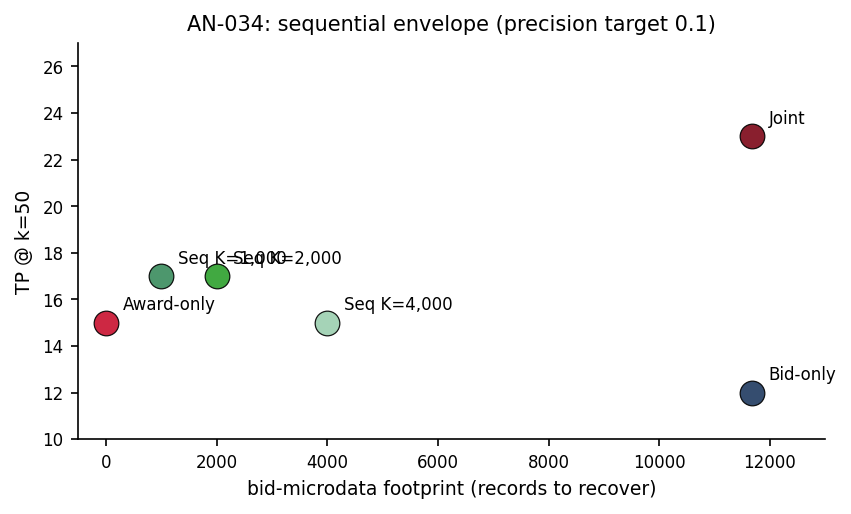
Figure: cost-of-evidence Pareto plot. X-axis: bid-microdata footprint (records to recover). Y-axis: TP at k=50 (precision target 0.10). Joint scoring is the Pareto frontier upper bound (23 TP, 11,676 microdata); Sequential K=1,000 and K=2,000 approximate the joint upper bound at 8-17% of the microdata cost; Award-only (0 microdata, 15 TP) is the zero-cost benchmark.
Cost-of-evidence trade-off¶
| Architecture | TP @ k=50 | Microdata cost | TP per microdata-record-recovered |
|---|---|---|---|
| Award-only | 15 | 0 | ∞ (no microdata) |
| Joint | 23 | 11,676 | 0.0020 |
| Sequential K=1,000 | 17 | 1,000 | 0.017 (8.6× more efficient than joint) |
| Sequential K=2,000 | 17 | 2,000 | 0.0085 (4.3× more efficient than joint) |
| Sequential K=4,000 | 15 | 4,000 | 0.0038 (1.9× more efficient than joint) |
Recovery as % of joint upper bound¶
| Architecture | TP @ k=50 | % of joint | Microdata as % of joint |
|---|---|---|---|
| Award-only | 15 | 65% | 0% |
| Joint | 23 | 100% | 100% |
| Sequential K=1,000 | 17 | 74% | 8.6% |
| Sequential K=2,000 | 17 | 74% | 17.1% |
| Sequential K=4,000 | 15 | 65% | 34.3% |
Interpretation¶
The envelope quantifies the operational trade-off:
-
Joint scoring is the upper bound (23 TP, 11.9% recall at k = 50) but requires full bid microdata on every firm (11,676 records).
-
Sequential FL → Imhof at Stage-1 K = 2,000 captures 74% of joint recall (17 TP vs 23) using 17% of the bid-microdata footprint (2,000 vs 11,676). This is the operational architecture that approximates the full-observability upper bound at substantially lower forensic cost.
-
Award-only achieves 65% of joint recall (15 TP) with ZERO bid-microdata cost. For agencies that cannot recover bid microdata at all, the award-layer screen alone preserves most of the discriminative value.
-
The bid-layer alone is the weakest of the four architectures (12 TP, 6.2% recall) — Imhof requires participation features to reach its headline performance (AN-010 shows Imhof CV-only = 0.585 chance-level). Bid-distribution features alone are not a substitute for award-layer information.
For H:award-bid-complementarity: the sequential envelope confirms the complementarity claim at the operational level. Award-layer signal is necessary; bid-layer signal adds incremental discrimination at additional microdata cost; joint is the upper bound; sequential approximates joint at lower cost.
This is the architecture defended in §6 of the manuscript: the award layer orders forensic priority, deciding where the bid layer is opened — a division of labor, not a cartel detector. The envelope is a cost–recall frontier: K = 2,000 is a reported operating point, not an optimal cutoff, and the joint benchmark is a full-observability upper bound rather than an attainable deployment target. AN-013 reports the temporal-holdout precision metrics under this architecture.
Follow-ups¶
- Same envelope under temporal holdout (test rules formed on 2009–2016
applied to 2017–2019 — partially in
temporal_holdout_table.csv). - Sensitivity to Stage-1 cutoff (smooth between K = 500 and K = 5,000).
- Precision targets 0.25 and 0.30 (the table only reports through 0.20 because Award-only doesn't reach higher).
- Add macros
\valSeqEnvJointTP,\valSeqEnvSeqKTwoTP,\valSeqEnvSeqKTwoMicrodatato thescripts/99_make_paper_values.Rpipeline.