Superseded numbers — canonical-target re-estimation (June 4, 2026)
This analysis note documents a historical run under the earlier validation label. On June 4, 2026 the paper adopted a reproducible, non-circular target (651 always-loser cobidders; frequent-loser flag never used in the label) and re-estimated every result. Where this page conflicts with the paper or the changelog, the paper wins.
AN-027: Universe-anchored stratum scope matrix
Intuition (plain-language)
An eight-cell matrix varies who gets ranked (always-losers vs all BEC firms) and what counts as a hit (cobidders vs direct defendants). Two lessons. First, the headline 0.924 is exposure-inflated: a firm that bids more simply has more chances to brush against a defendant, and an opportunity decomposition shows exposure alone scores 0.946 while the genuine within-stratum increment is only +0.042 (still real, p ≈ 2e-6). Second, the disciplining row — ranking by raw participation against direct defendants gives AUC 0.383, below random — shows the loser-side score actively repels winner-heavy ringleaders. The method separates genuine signal from opportunity arithmetic; it is not a generic detector.
Question
How does AUC behave when the universe (the set of firms or items being ranked) and the positive class (the validation target) are systematically varied? The meta-table documents what the loser-side score targets and what it does NOT target — the scope discipline that converts "the screen works" into "the screen works on a specific, declared population".
Design
- Universes:
- Always-loser firms: 16,843 firms with
win_rate == 0in BEC 2009–2019. - All BEC firms: 41,444 firms in the registry.
- Items 2017-2019: 1,009,729 items used for prospective evaluation.
- Always-losers as of 2009-2016: 21,819 firms for the frozen-cutoff variant.
- Positive classes:
- Cobidders inside always-loser stratum (193 firms);
- Direct CADE defendants in full BEC (47 firms);
- Cobidder-bearing items 2017-2019 (5,299 items);
- Direct-defendant-bearing items 2017-2019 (12,037 items).
- Scores: FL14 binary; continuous log(1 + tenders_count); participation count in the full-BEC universe; frozen binary and continuous variants from the 2009-2016 train window.
Results
The 8-row scope matrix (source CSV stratum_scope_metrics.csv):
| # | Score | Universe | Positive class | AUC | 95% CI | N+ | N |
|---|---|---|---|---|---|---|---|
| 1 | Binary FL rule | Always-losers | Cobidders | 0.924 | [0.921, 0.926] | 193 | 16,843 |
| 2 | Continuous log_tc | Always-losers | Cobidders | 0.939 | [0.932, 0.946] | 193 | 16,843 |
| 3 | Binary FL rule | All BEC firms | Direct CADE | 0.491 | [0.461, 0.520] | 47 | 41,444 |
| 4 | Participation count | All BEC firms | Direct CADE | 0.383 | [0.322, 0.443] | 47 | 41,444 |
| 5 | Binary FL frozen on 2009-2016 | Always-losers as of 2009-2016 | Cobidders | 0.767 | [0.734, 0.800] | 193 | 21,819 |
| 6 | Continuous item score trained on 2009-2016 | Items 2017-2019 | Cobidder-bearing items | 0.770 | [0.764, 0.776] | 5,299 | 1,009,729 |
| 7 | Binary item flag frozen on 2009-2016 | Items 2017-2019 | Cobidder-bearing items | 0.565 | [0.564, 0.566] | 5,299 | 1,009,729 |
| 8 | Continuous item score trained on 2009-2016 | Items 2017-2019 | Direct-defendant items | 0.511 | [0.510, 0.513] | 12,037 | 1,009,729 |
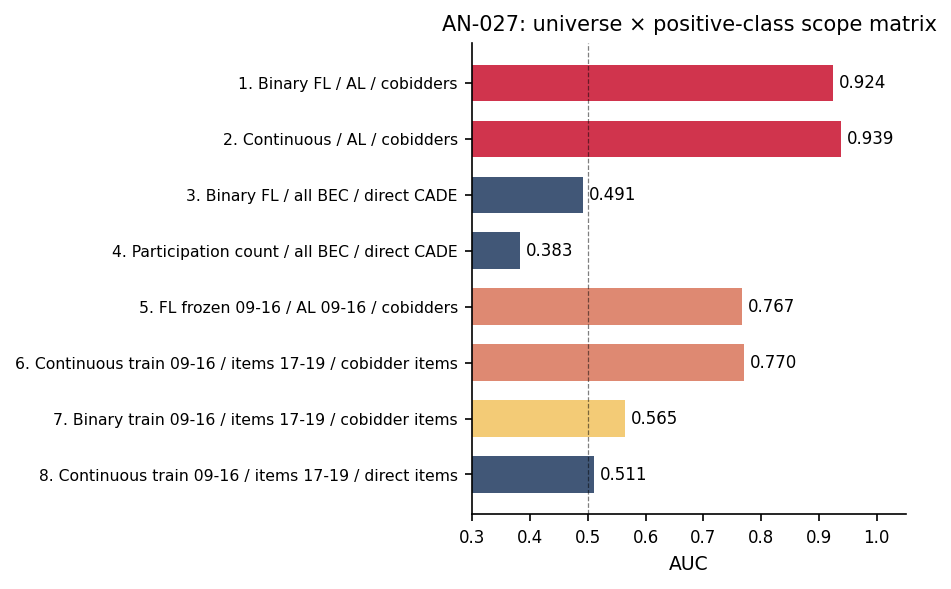
Figure: AUC across the 8 (universe × positive class × score) rows. Red bars: rows 1-2 (where the score should work — 0.92–0.94 against cobidders within always-losers). Navy bars: rows 3-4, 7-8 (where the score should not work — near 0.5 against direct defendants). Intermediate (orange/amber): rows 5-6 (timing-disciplined cobidder targets). Row 4 below 0.5: participation count actively repels winner-heavy defendants.
Headline readings from the source CSV:
- Row 1: "Within-stratum prioritization only" — the binary rule prioritizes cobidder risk inside the always-loser stratum.
- Row 2: "Best within-stratum ranking object" — the continuous score is the empirical primitive.
- Row 3: "No; performance is at chance" — the score does not detect cartel defendants in general (predicted null).
- Row 4: "No; loser-side scores miss winner-heavy defendants" — and actively repel them: AUC = 0.383 means the score discriminates against direct defendants (a high-participation firm is less likely to be a direct CADE defendant under the screen).
- Row 5: "Much weaker than pooled within-stratum performance" — strict ex ante variant.
- Row 6: "Some prospective generalization, but narrower and weaker".
- Row 7: "No; binary holdout performance is weak" — the item-level binary flag does not generalize prospectively.
- Row 8: "No; direct-defendant scope failure remains" — direct-defendant null survives temporal holdout.
Opportunity decomposition (the headline reframe)
The raw within-stratum AUC numbers (rows 1–2: 0.924 / 0.939) are exposure-inflated pooled numbers: most of the apparent concentration is opportunity arithmetic — firms that bid in more tenders mechanically have more chances to co-bid with a defendant. The v22 contribution is to decompose that raw signal:
- Exposure-only (rank firms by bidding opportunity alone): AUC 0.946 — i.e. raw opportunity by itself reproduces almost all of the pooled discrimination.
- Within-stratum (hold opportunity fixed, ask whether the loser-side score still ranks): AUC 0.7715.
- Genuine increment (the signal that survives once opportunity is netted out): +0.042, DeLong p ≈ 2 × 10⁻⁶.
So the honest claim is not "the screen discriminates at 0.92". It is: raw concentration is mostly opportunity, and a limited but real signal (+0.042) survives the opportunity match. The volume- and opportunity-matched audits (AN-041, AN-042) reach the same verdict from the firm-profile side. This is a decomposition method — separating genuine loser-side signal from opportunity arithmetic — not a cartel detector.
Interpretation
The scope matrix is the systematic alternative-hypothesis sweep that H:exposure-discipline needs. Eight different (universe × positive-class) combinations:
- Where the score should work, it does (rows 1, 2): AUC 0.924–0.939 on cobidders within always-losers.
- Where the score should not work, it doesn't (rows 3, 4, 8): AUC ≈ 0.5 against direct defendants in any universe.
- Row 4 is stronger than just "null": participation count on full BEC vs direct defendants is 0.383 — below random. This is the discriminating-against-winners result. A high-participation BEC firm is less likely to be a direct CADE defendant — exactly the sign predicted by the loser-side scope interpretation. Direct defendants are winner-heavy (AN-018: 14.9% always-losers, median win rate 0.261), so they sit at lower loser-side participation than non-defendants.
- Frozen variants preserve the pattern under timing discipline (rows 5, 6, 7, 8): the loser-side scope and the AUC magnitudes degrade gracefully, the direct-defendant null remains.
The matrix structurally rules out the "the screen picks up something generic" reading. The score targets exactly what the loser-side framing predicts and misses exactly what the framing says it should miss.
For H:exposure-discipline, the combination of (i) sham permutation rejecting at p = 0 (AN-005), (ii) leakage audit surviving at 0.864 (AN-014), (iii) this scope matrix showing the score targets the right population in every cell, is near-exhaustive within-data evidence that the result is not an artifact.
Follow-ups
- Add a within-modality variant of the matrix (Pregão-only and Convite-only sub-samples).
- Triangulate row 4 (participation count vs direct defendants, AUC 0.383) with the D4 mechanistic check (AN-018).
- Cross-validate the prospective rows (6, 7, 8) under alternative train windows.
- Add macros
\valScopeRowOnethrough\valScopeRowEightand a\valAUCParticDefendants(= 0.383) macro to thescripts/99_make_paper_values.Rpipeline.