Superseded numbers — canonical-target re-estimation (June 4, 2026)
This analysis note documents a historical run under the earlier validation label. On June 4, 2026 the paper adopted a reproducible, non-circular target (651 always-loser cobidders; frequent-loser flag never used in the label) and re-estimated every result. Where this page conflicts with the paper or the changelog, the paper wins.
AN-026: Subsample robustness (data-rich vs low/high bid counts)
Intuition (plain-language)
Does the result only work for firms with rich bid histories? If so it would inherit the data dependence of the expensive screens it claims to replace. It doesn't: FL14 AUC stays in a tight band (0.887–0.912) across data-rich, low-bid, and high-bid subsamples. That data-independence is the whole operational selling point — the award-layer screen runs on cheap administrative records whether or not bid microdata exists.
Question
Does the cobidder concentration result survive across always-loser sub-populations defined by bid-microdata availability? This is the right cross-cut for the cost-of-evidence argument (H:gatekeeping-cost-of-evidence) and for the complementarity claim (H:award-bid-complementarity): if the FL signal were merely picking up bid-data availability, AUC would track availability across the subsamples. It does not.
Design
- Full sample: 16,843 always-losers; 193 cobidders.
- Subsamples:
- full: all 16,843 firms.
- data_rich: firms with bid microdata available (N = 12,575; 193 cobidders).
- low_n_bids: firms with low bid count (N = 11,134; 132 cobidders).
- high_n_bids: firms with high bid count (N = 5,709; 61 cobidders).
- Scores evaluated per subsample:
- is_fl: FL14 binary indicator;
- tenders_count: continuous log_tc;
- imhof_cv: bid coefficient of variation;
- imhof_log_sd: log SD of bids.
Results
AUC × subsample × score (selected; full table in source CSV):
| Subsample | FL14 | log_tc | Imhof CV | Imhof log_sd | N | N+ |
|---|---|---|---|---|---|---|
| full | 0.924 | 0.939 | 0.854 | 0.790 | 16,843 | 193 |
| data_rich | 0.887 | 0.918 | 0.840 | 0.781 | 12,575 | 193 |
| low_n_bids | 0.909 | 0.933 | 0.847 | 0.765 | 11,134 | 132 |
| high_n_bids | 0.912 | 0.962 | 0.865 | 0.824 | 5,709 | 61 |
All AUCs come with 95% bootstrap CIs in the source CSV. Selected CIs:
- FL14 full: [0.898, 0.925]
- log_tc full: [0.932, 0.946]
- log_tc high_n_bids: [0.954, 0.970] — tightest in the high-bid-count cell where the score discriminates most.
- FL14 high_n_bids: [0.875, 0.950] — widest in the smallest subsample.
Source: output/auc_by_subsample/auc_subsample.csv.
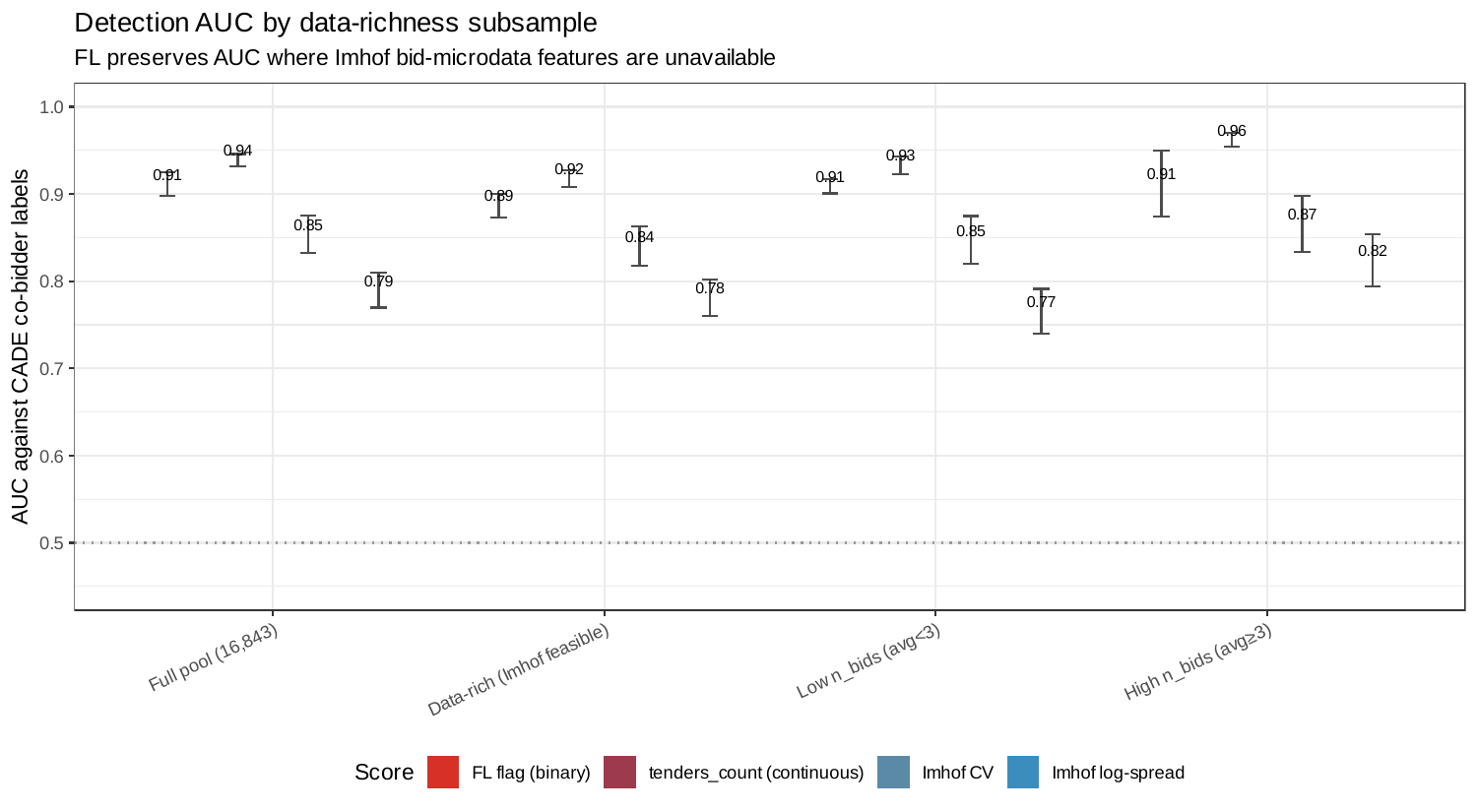
Figure: AUC point estimates with 95% CIs across the four subsamples (full / data_rich / low_n_bids / high_n_bids) crossed with the four scores (FL14, log_tc, Imhof CV, Imhof log_sd). FL14 AUC stable in the 0.89–0.91 band across subsamples; log_tc dominates in every cell; Imhof scores below the award-layer scores throughout.
Interpretation
Four readings, all supporting H1:
-
FL signal does not depend on bid-microdata richness. FL14 AUC is 0.924 in the full sample, 0.887 in data-rich, 0.909 in low-bid, 0.912 in high-bid. Range = 0.025. The signal carries across the data richness margin — the screen is not a proxy for "we have lots of bid data on this firm".
-
Continuous score dominates in every subsample. log_tc AUC exceeds FL14 in all four cells (0.939 > 0.924 full; 0.918 > 0.887 data-rich; 0.933 > 0.909 low-bid; 0.962 > 0.912 high-bid). The horse-race result of AN-011 is not driven by any one subsample.
-
Imhof CV is informative but lower across the board. Imhof CV AUC 0.84–0.87 across subsamples — well above chance, but consistently below the award-layer scores. This is the same complementarity pattern as AN-010 and supports the "two layers operate at different evidentiary stages" framing.
-
High-bid-count cell is the tightest discriminator. log_tc AUC reaches 0.962 in the high-bid-count subsample. This is where the joint scoring of AN-010 approaches its full-observability ceiling. The cell is small (N = 5,709) but gives the cleanest read.
The subsample sweep is the cross-cut that the JLEO reviewer will ask for: "does your result come from the same firms that have rich bid data?" The answer is no — the screen carries across the data-availability margin.
Follow-ups
- Decomposition by procurement modality crossed with bid-data richness.
- Sub-period × subsample crossover.
- Add macros
\valAUCSubsampleFull,\valAUCSubsampleDataRich,\valAUCSubsampleLowBids,\valAUCSubsampleHighBids(per score) toscripts/99_make_paper_values.R.