Administrative vs Ordinary Purchases
Overview
This analysis compares administrative purchases (urgency without judicial sanctions) to ordinary purchases, excluding litigated purchases entirely. The sample includes items with both administrative and ordinary purchase types (196,988 observations; 168,814 winners).
Key Results (Preferred Specification: Item + Year + PBU FE)
| Outcome | Coefficient | % Effect | Significance |
|---|---|---|---|
| Reference Price | -0.095 | -9.1% | * |
| Quantity | +0.457 | +57.9% | n.s. |
| Neg. Price (Total) | -0.062 | -6.0% | n.s. |
| Neg. Price (Direct) | +0.109 | +11.5% | n.s. |
| Firms (Total) | -0.027 | -2.6% | n.s. |
| Firms (Direct) | -0.037 | -3.6% | * |
| Success (Total) | +0.009 | +0.9 pp | n.s. |
| Success (Direct) | +0.001 | +0.1 pp | n.s. |
Interpretation
Administrative purchases carry lower reference prices than ordinary purchases (-9.1%, p < 0.10), a striking contrast with litigated purchases which carry +7.6% higher prices. Most other effects are imprecisely estimated. This confirms that administrative purchases occupy an intermediate position: they share urgency constraints but lack the price-inflating effects of judicial sanctions.
Coefficient Plot
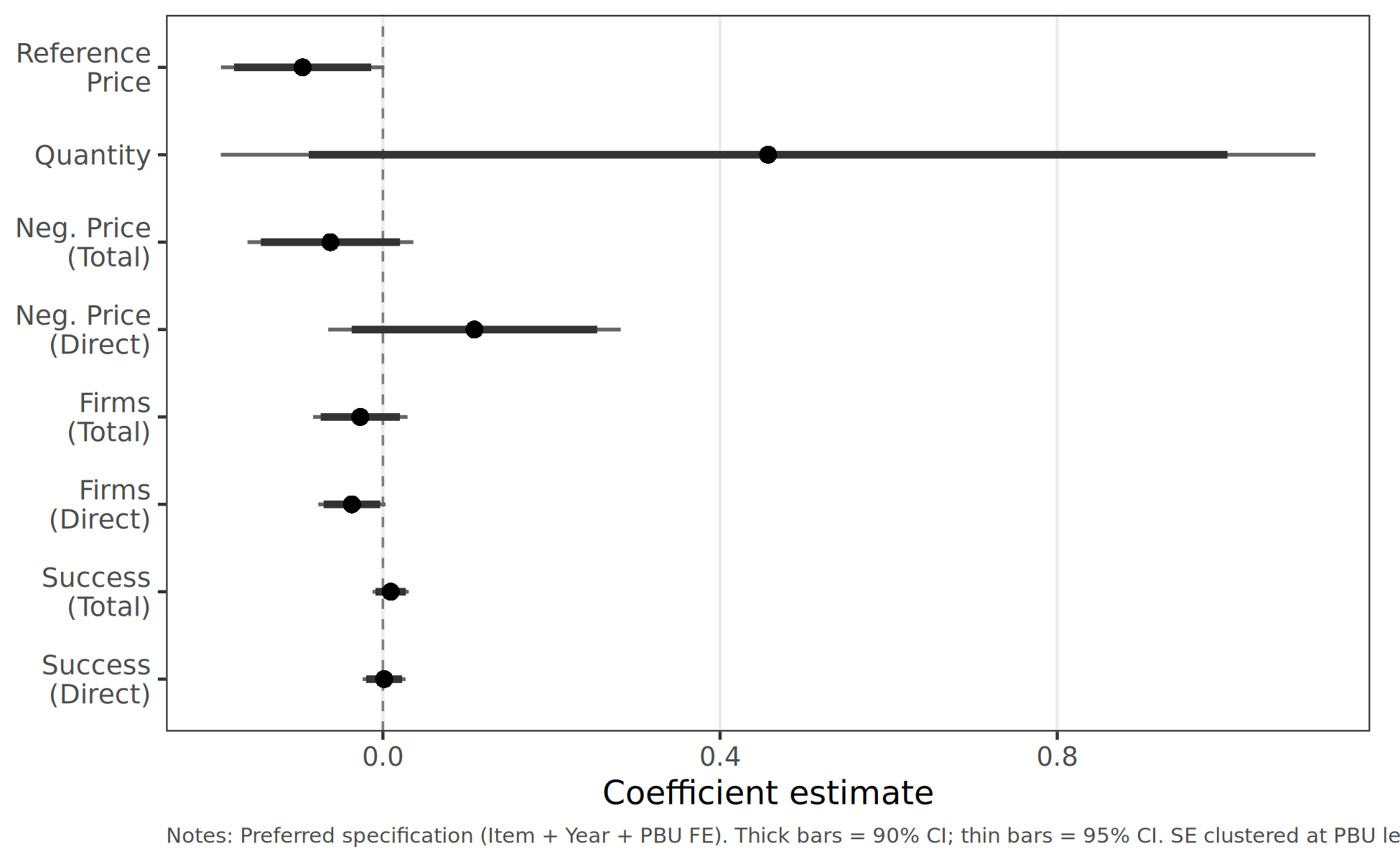
Preferred specification (Item + Year + PBU FE). Thick bars = 90% CI; thin bars = 95% CI. SE clustered at PBU level.
Comparison Across All Groups
| Outcome | Urgent vs Ord | Litigated vs Ord | Admin vs Ord | UTG (Admin vs Lit) |
|---|---|---|---|---|
| Ref. Price | +2.7%* | +7.6%** | -9.1%* | -27.3%*** |
| Neg. Price (Total) | +5.4%*** | +9.1%*** | -6.0% | -30.0%** |
| Firms (Total) | -5.5%*** | -7.9%*** | -2.6% | n.s. |
| Success | +2.1pp*** | +2.4pp*** | +0.9pp | n.s. |
Key Takeaway
The gradient of effects across comparison groups—largest for litigated vs ordinary, moderate for urgent (pooled), and reversed for admin vs ordinary—confirms that judicial sanctions, not urgency per se, drive the procurement cost premium.
Quantity channel in the UTG effect
Controlling for log quantity in the UTG specification reduces the coefficient from \(-0.262\) to \(-0.117\) (statistically insignificant). Judicial sanctions distort the entire procurement environment—quantities, competition, and prices—generating a total cost premium that the administrative comparison isolates cleanly. The attenuation confirms that a substantial share operates through the quantity channel: sanctions prevent demand aggregation, yielding smaller orders and forgoing bulk discounts.