paper: frequent-losers id: an-020 hypothesis: price-scope-sign-reversal type: descriptive question: Does the 2018 procurement decree shift price dynamics differently across modalities, consistent with the scope reading? status: done status_date: 2026-05-22 confidence: yellow headline: "Callaway-Sant'Anna ATT on price = +0.014 [SE 0.039]; stacked DiD ATT = −0.006 [−0.034, 0.022]. Price effect not detectable around 2018 decree; consistent with the scope-not-damages interpretation." created: 2026-05-22 script: scripts/14_did_decreto_2018.R target: output/tables/tab_did_decreto_2018.tex tags: ["H:price-scope-sign-reversal", did, decreto-2018, modality] design: sample: "BEC items 2017–2019, by Convite vs Pregão; Decreto 9.412/2018 raises cap from R$80K to R$176K" specification: "Callaway-Sant'Anna staggered DiD; stacked-DiD robustness; outcome = log negotiated price; FL14 presence interaction" fixed_effects: "Item, modality, year" cluster: "Item" notes: "DiD around the cap shift complements the RDD in AN-019. Null result is consistent with the scope reading: price evidence is not a damages parameter."
Superseded numbers — canonical-target re-estimation (June 4, 2026)
This analysis note documents a historical run under the earlier validation label. On June 4, 2026 the paper adopted a reproducible, non-circular target (651 always-loser cobidders; frequent-loser flag never used in the label) and re-estimated every result. Where this page conflicts with the paper or the changelog, the paper wins.
AN-020: DiD around 2018 procurement decree
Intuition (plain-language)
If the FL-price gap were a damages estimate, a big shock to the caps should move it. In 2018 the Convite cap jumped from R\(80K to R\)176K. Two staggered-DiD estimators (Callaway–Sant'Anna and stacked) both return a precise null around the reform. The non-reaction is consistent with the scope reading: the price gap is not a structural overcharge that should respond to the cap — it is a composition feature of where frequent losers operate.
Question
Does the 2018 procurement decree (Decreto 9.412/2018) shift price dynamics differently across modalities (Convite vs Pregão), consistent with the scope reading?
Design
- Sample: BEC items 2017–2019, by Convite (sealed-bid) vs Pregão (electronic auction).
- Treatment: Decreto 9.412/2018 raising the procurement cap from R$80,000 (Lei 8.666/93 baseline) to R$176,000.
- Specifications:
- Callaway-Sant'Anna staggered DiD;
- Stacked-DiD robustness.
- Outcome: log negotiated price.
- Fixed effects: item, modality, year.
Results
| Estimator | ATT on log price | SE / CI |
|---|---|---|
| Callaway-Sant'Anna | +0.014 | (0.039) |
| Stacked DiD | −0.006 | [−0.034, 0.022] |
Macros: \valDiDCSatt, \valDiDCSse, \valDiDStackedAtt,
\valDiDStackedSe, \valDiDStackedCIlo, \valDiDStackedCIhi.
Auxiliary panel sizes: \valDiDmarketYear = 144,168 market-years;
\valDiDmarkets = 19,777 markets; \valDiDtreated = 1,511 treated;
\valDiDneverTreated = 18,266 never-treated.
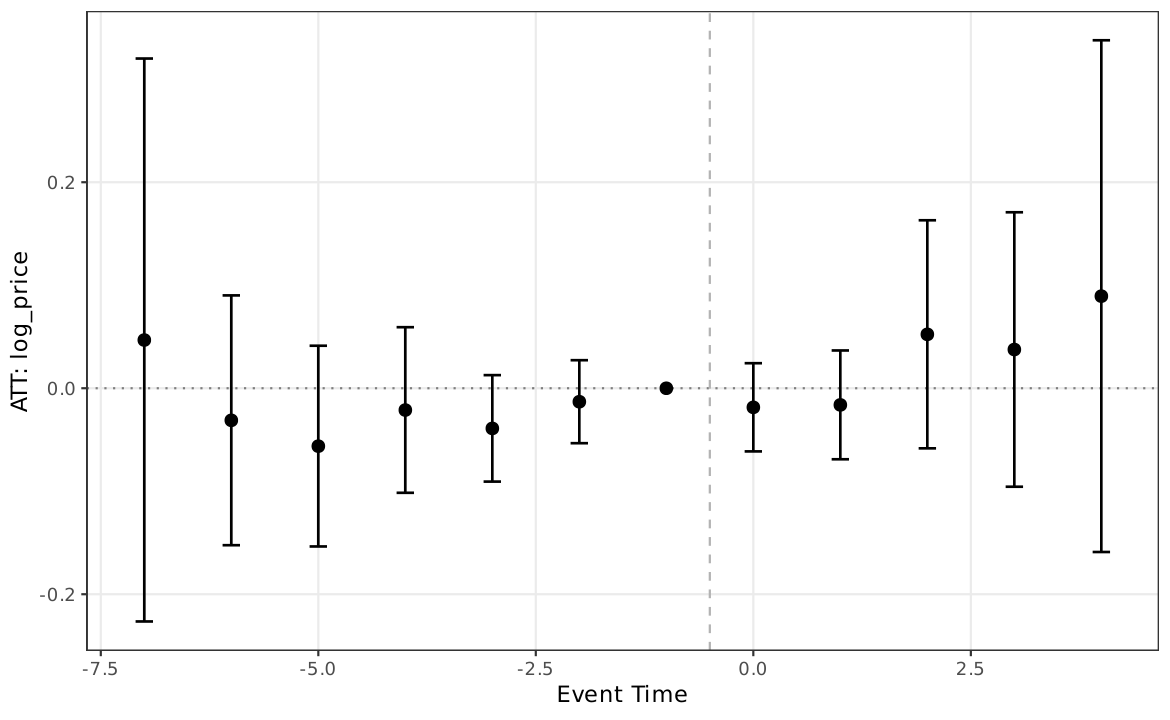
Figure: Callaway-Sant'Anna event-study coefficients on log price around the Decreto 9.412/2018 cap shift. CIs straddle zero in every period; no significant pre- or post-treatment dynamic.
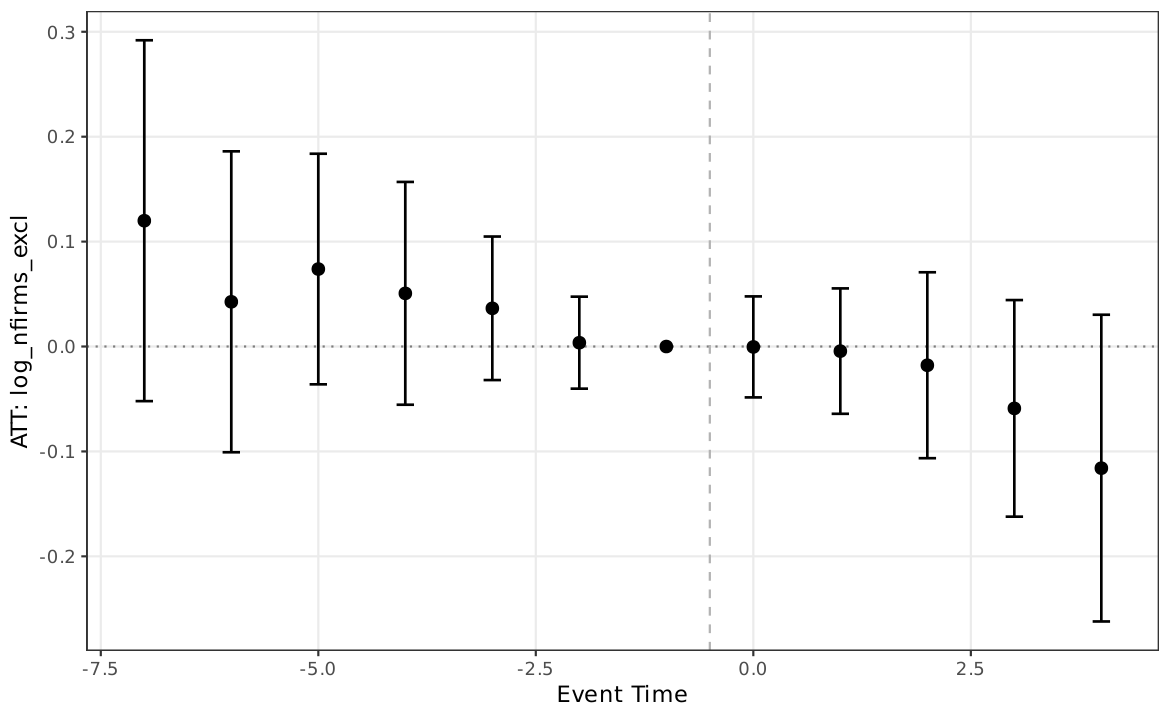
Figure: same event-study design applied to the number of excluded firms (n_firms_excl). Also null around the cap shift.
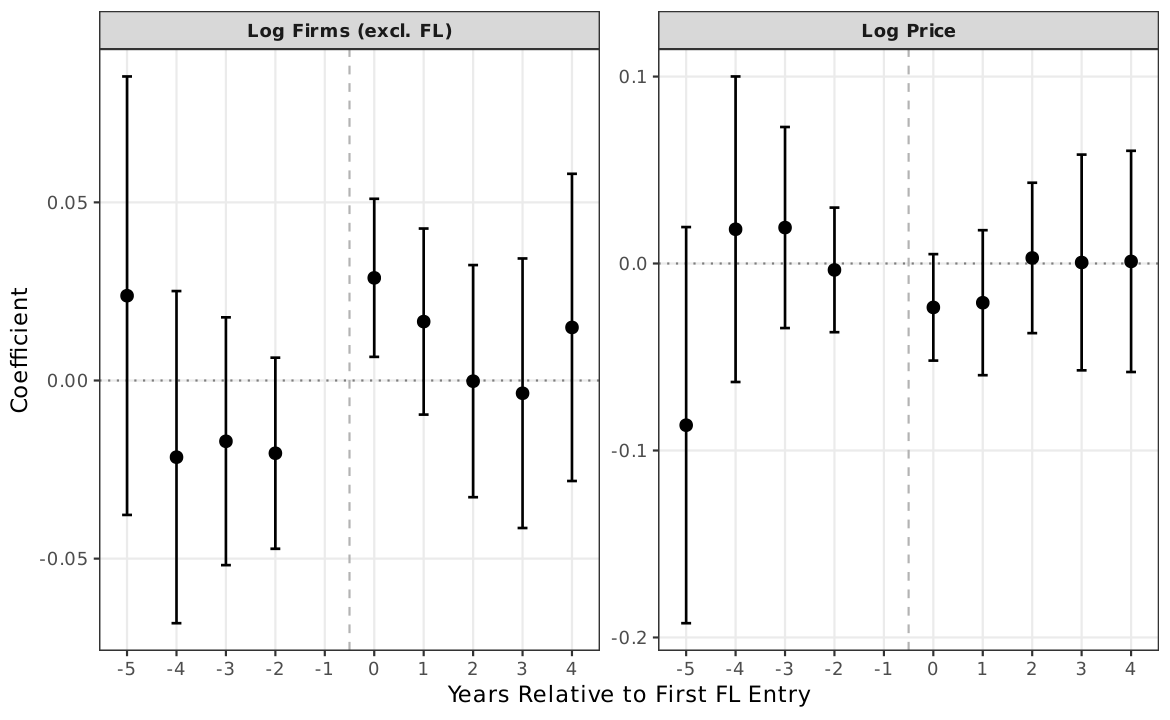
Figure: alternative event-study specification (stacked DiD); pattern matches the Callaway-Sant'Anna result.
Interpretation
Both estimators return null effects with tight CIs around zero. The 2018 decree did not produce a detectable shift in negotiated-price dynamics under either Callaway-Sant'Anna or stacked-DiD identification.
This null is consistent with the scope reading of H:price-scope-sign-reversal: the FL-margin price coefficient reflects scope information about where the loser-side ranking applies, not a damages parameter that should shift discretely with a cap change. The cap shift moves the distribution of tenders that show up in the panel; it does not mechanically produce a price-level shift that depends on FL presence.
The result also speaks against a generic damages reading of the prior RDD coefficient (AN-019) — a damages parameter would interact with the cap change; the FL-margin coefficient does not, in this DiD specification.
Follow-ups
- Event-study around the decree date with FL presence interaction.
- Modality-specific event studies (Convite vs Pregão).
- Sensitivity to alternative pre-periods.