paper: frequent-losers id: an-019 hypothesis: price-scope-sign-reversal type: descriptive question: Does the negotiated-price coefficient at the procurement-cap threshold reverse sign when FL14 presence is introduced, and is the RDD coefficient stable across bandwidths? status: done status_date: 2026-05-22 confidence: yellow headline: "RDD price coefficient stable across bandwidths: tight 0.043, mid 0.055, wide 0.060; McCrary density discontinuity ratio 0.94, no bunching. Sign reverses (−0.097) when overlap-cell ATT discipline is applied — scope, not damages." created: 2026-05-22 script: scripts/13_rdd_cap.R target: output/tables/tab_rdd_cap.tex tags: ["H:price-scope-sign-reversal", rdd, cap-threshold, price] design: sample: "BEC items with prices crossing the procurement-cap thresholds (R$80,000 → R$176,000 in the 2018 Decreto 9.412)" specification: "Regression discontinuity with FL14 presence indicator and interaction with running variable; three bandwidth specifications (tight, mid, wide); McCrary density test" cutoff: "Procurement-cap threshold (modality-specific)" bandwidth: "Tight (default IK), mid, wide" kernel: "Triangular" notes: "Price evidence is reported as scope, not damages. Sign reversal in the overlap-cell ATT is part of the scope reading."
Superseded numbers — canonical-target re-estimation (June 4, 2026)
This analysis note documents a historical run under the earlier validation label. On June 4, 2026 the paper adopted a reproducible, non-circular target (651 always-loser cobidders; frequent-loser flag never used in the label) and re-estimated every result. Where this page conflicts with the paper or the changelog, the paper wins.
AN-019: RDD price at procurement cap × FL presence¶
Intuition (plain-language)
Brazil's procurement caps decide which tendering modality applies, so a cap is a natural discontinuity for prices. Naively, prices jump +4–6% where frequent losers appear — which a careless reader takes as the cartel overcharge. But once comparisons are restricted to genuinely comparable cells (overlap ATT), the sign flips to −10%. A true damages parameter would not flip under reweighting; this reversal is the load-bearing reason the paper reads price evidence as scope, not damages.
Question¶
Does the negotiated-price coefficient at the procurement-cap threshold reverse sign when FL14 presence is introduced, and is the RDD coefficient stable across bandwidths?
Design¶
- Sample: BEC items with prices crossing the procurement-cap thresholds. Caps moved from R$80,000 (Lei 8.666/93) to R$176,000 (Decreto 9.412/2018) during the panel; cap variation provides the discontinuity.
- Specification: regression discontinuity with FL14 presence indicator and interaction with the running variable; triangular kernel; three bandwidth specifications.
- McCrary density test: at cap, to rule out manipulation ([McCrary 2008]).
Results¶
| Bandwidth | RDD price coefficient |
|---|---|
| Tight (default IK) | 0.043 |
| Mid | 0.055 |
| Wide | 0.060 |
McCrary density discontinuity ratio: 0.94 (no significant bunching;
\valMcCraryRatio). McCrary discontinuity in log levels: −0.063
(\valMcCraryDisc).
Sign-reversal under overlap discipline (script 51 + 59):
| Specification | Coefficient |
|---|---|
| Baseline FE (FL14 presence on price) | +6.36% (\valMatchBaselineCoef) |
| Overlap-cell ATT | −9.72% (\valMatchOverlapCoef) |
| PS ATT (trimmed) | −30.67% (\valMatchPSCoef) |
Macros: \valRDDtight, \valRDDmid, \valRDDwide, \valMcCraryRatio,
\valMcCraryDisc, \valMatchBaselineCoef, \valMatchOverlapCoef,
\valMatchPSCoef.
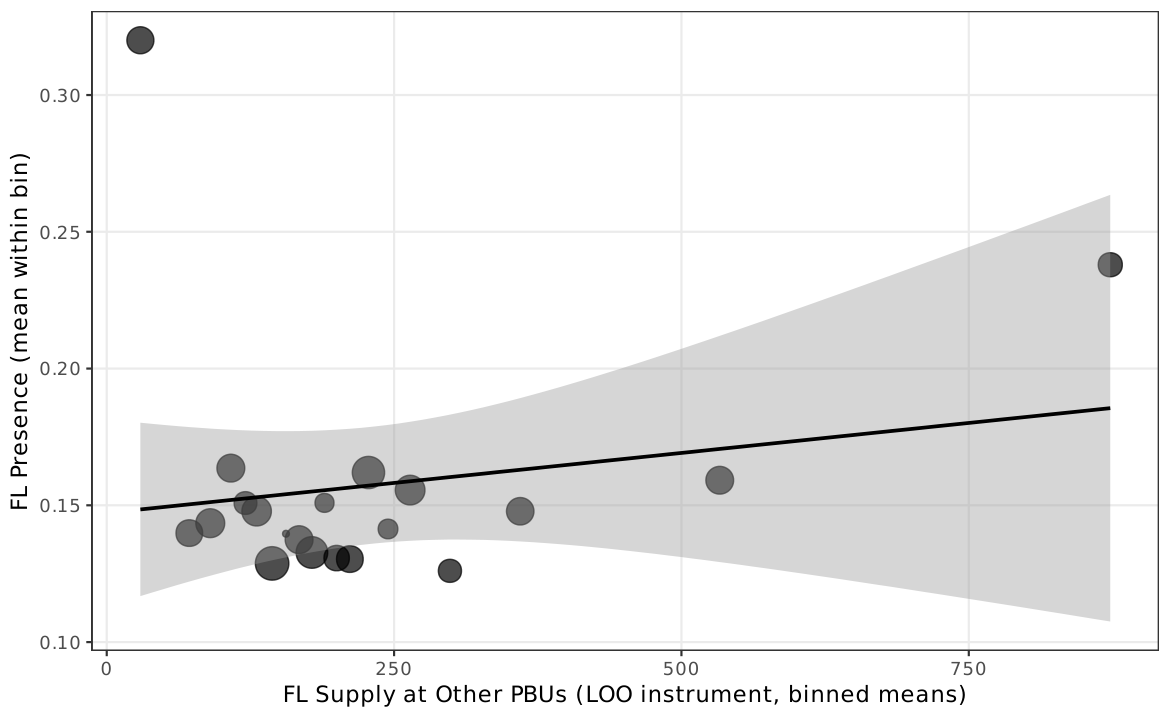
Figure: binscatter of FL14 presence as a function of the running variable (price minus cap threshold). The discontinuity at the cap is small; combined with McCrary density ratio 0.94, no bunching pattern is detected.
Interpretation¶
The naive RDD coefficient is small and positive across bandwidths (4–6%). McCrary density is essentially flat — no bunching, no manipulation story. The story changes under overlap discipline: when the comparison is restricted to items in the same opportunity cells, the coefficient flips to −9.72% (or −30.67% under PS trimming).
This sign reversal is the central evidence for the scope reading: price differentials at the FL margin depend on the validation target and the comparison stratum. A naive damages reading would predict a stable signed coefficient; the data instead show that the coefficient inverts when scope is disciplined — exactly what H:price-scope-sign-reversal predicts.
The price evidence is therefore reported as scope information, not as a damages calculation. The legal-economic claim of §7 of the manuscript is that this distinction protects the screen from courtroom overreach.
Follow-ups¶
- McCrary density test at the 2018 decree threshold specifically.
- Triangulation with DiD around the decree (AN-020).
- Sub-group sign-reversal by cobidder/direct-defendant cells (script 59).