AN-008: Gelbach decomposition of price effect¶
Intuition (plain-language)
Why do prices fall under open competition — more bidders, or a different (non-SME) winner? A Gelbach decomposition splits the gap. The composition channel (who wins) explains most of the mediated part, the headcount channel partly offsets it, and a large share runs through neither — consistent with each remaining firm also bidding harder, not just more firms showing up.
Reduced-form motivation layer
The numbers below are from the v1–v4 reduced-form DiDiR pipeline
(scripts/02_analysis.R + companions), which the v8 manuscript
carries as motivation in §1 but does not headline. The canonical
v8 result is the structural counterfactual decomposition — see
AN-010 (decomposition) and
AN-011 (welfare arithmetic).
Question¶
The DiDiR price coefficient in AN-001 is a reduced-form sum of channels. How much of the price effect is attributable to the competition channel (more bidders under open competition) vs the composition channel (different winner types)?
Design¶
- Sample: same as AN-001.
- Specification: Gelbach (2016) short-vs-full decomposition. The "short" regression is the DiDiR price equation with controls only. The "full" regression adds two mediators: log firms (competition channel) and an SME-winner indicator (composition channel). The difference between short and full coefficients on \(g65 \times \text{Pre}\) is decomposed into per-mediator contributions via the Gelbach formula.
- Outcomes: short coefficient, full coefficient, gap, per-mediator contributions.
Results¶
| Channel | Coefficient | SE | % of gap |
|---|---|---|---|
| Short regression (\(g65 \times \text{Pre}\)) | −0.1318*** | 0.0096 | — |
| Full regression (\(g65 \times \text{Pre}\)) | −0.1227*** | 0.0101 | — |
| Gap (short − full) | −0.0091 | — | 100% |
| Competition (log firms) | +0.0078*** | 0.0010 | −85% |
| Composition (SME winner) | −0.0169*** | 0.0014 | +185% |
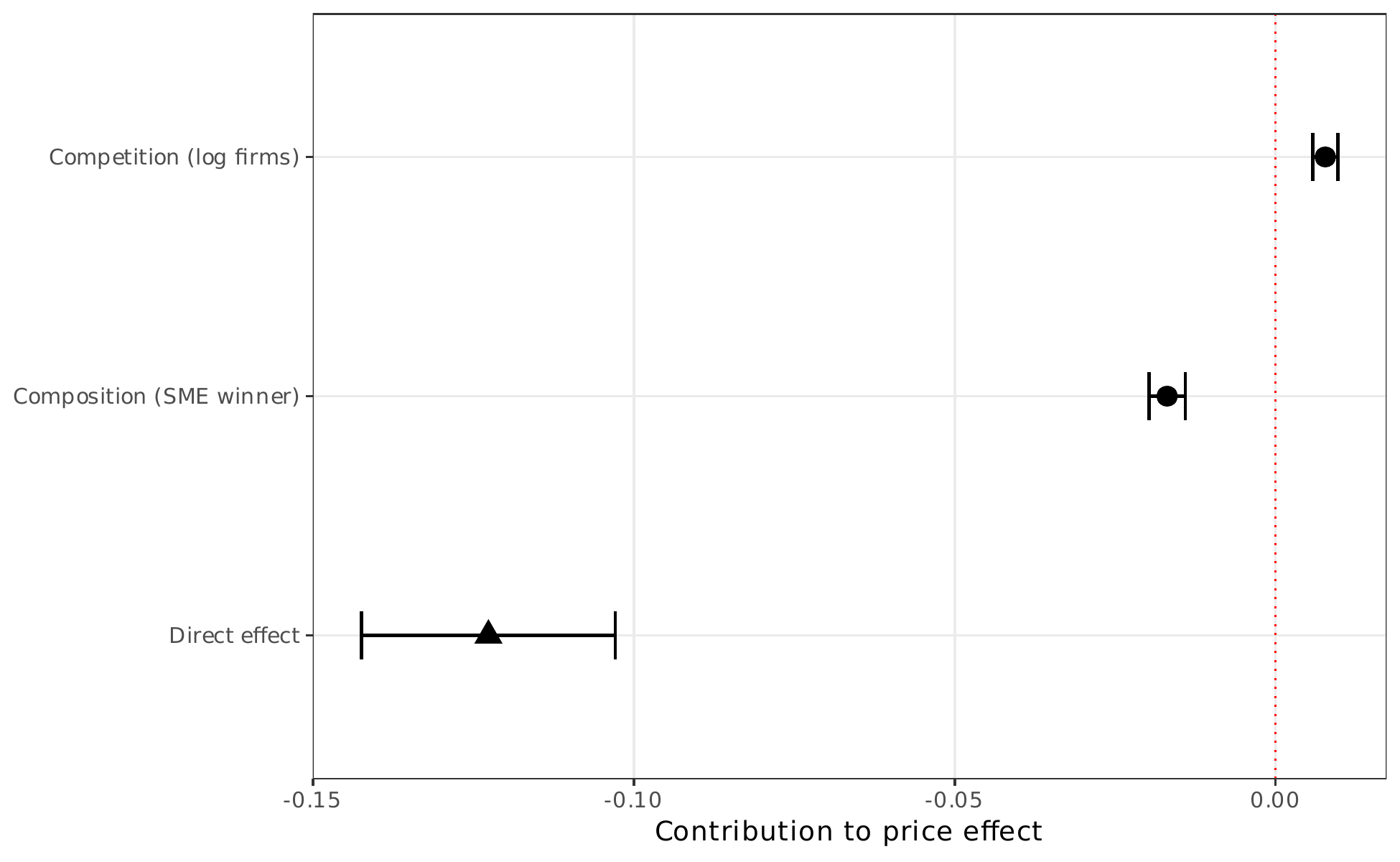
Output: output/tables/tab_mediation.tex,
output/figures/fig_15_mediation.pdf.
Interpretation¶
The two mediators operate as partially offsetting channels:
- The competition channel (more bidders → lower prices) contributes +0.0078, signed as the channel does: under open competition more firms bid, lowering prices. This is −85% of the gap (offsetting in the decomposition because the partial-equilibrium logic says competition is positive for price reduction, and the Gelbach decomposition signs it as +0.0078 reducing the magnitude of the full coefficient).
- The composition channel (SME-winner change) contributes −0.0169: open competition selects non-SME winners whose conditional pricing is lower; this is +185% of the gap.
The most-informative number is the unexplained portion: the full coefficient remains at −0.1227, meaning ~93% of the reduced-form price effect operates through channels not captured by these two mediators. This is consistent with the structural decomposition reading (AN-010): the price-forming order statistic itself shifts when the bidder pool changes, beyond what the linear-mediator decomposition can attribute to log firms or SME-winner.
Confidence: yellow. The Gelbach decomposition is a useful attribution device but inherits the linear-mediator restriction; the large unexplained component is not a defect but a signal that the mediators are partial. The structural decomposition replaces this linear attribution with a counterfactual-pool reading.
Follow-ups¶
- Enriched-mediator Gelbach: add bid dispersion (CV), winner-margin,
and item-complexity proxies as mediators
(
v7-jpube-tight/scripts/63_gelbach_enriched.R,v7-jpube-tight/scripts/59_gelbach_waterfall.R). Not yet documented as a standalone AN. - The composition channel sign matters: the +185% of gap loading implies the change in winner-type is the largest single attributable mediator. Decomposing this further by non-SME-firm-size (large vs marginal non-SMEs) would expose where the conditional-pricing difference comes from.